

An electrical maintenance tender should buy defined work, controlled access and usable evidence—not an unspecified number of visits. For an FDI factory in Vietnam, the owner needs an asset-based scope that bidders can measure, an agreed outage and responsibility boundary, and records the facility team can use after the contractor leaves. A low annual fee is difficult to compare when one offer includes shutdown testing and another includes only visual inspections.
This guide concerns procurement of an ongoing industrial electrical maintenance service. It is not an equipment maintenance manual, a switching procedure, a statutory inspection schedule or a certification of the factory. No price, client, actual site performance or contractor appointment is implied. All workload figures below are transparent hypothetical inputs.
Prepared for QuangAnhcons · Editorial focus: FDI factory electrical maintenance procurement and service evidence · Sources checked: 14 October 2026.
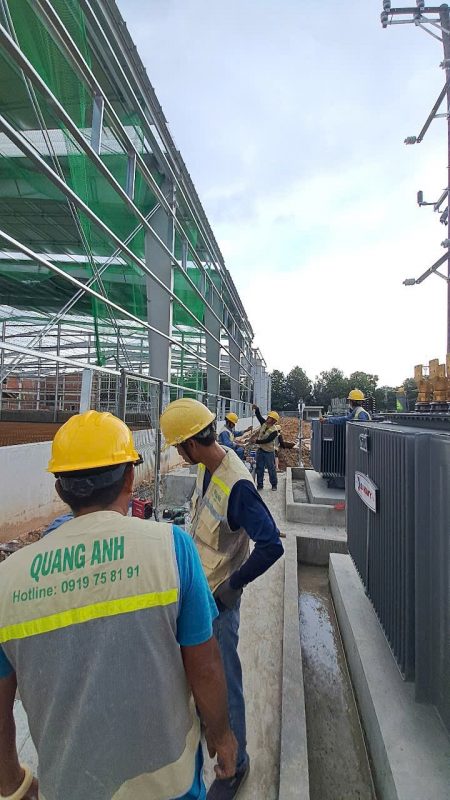
Featured image: historical QuangAnhcons electrical-project archive, illustrating equipment/access context—not a photograph of the hypothetical maintenance service.
1. Make the asset register the measurable contract boundary
Start with equipment tags, locations and ownership, then connect each asset to the controlled single-line diagram. Describe the electrical path from the serving utility or industrial-park supply through MV equipment, transformers, LV boards and factory feeders. Mark generators, ATS arrangements, UPS, PV and BESS connections where present. These sources can affect access, isolation and responsibility even when their own maintenance is supplied by another contractor.
An inventory containing only “one substation and ten panels” leaves too much unresolved. Different transformer technologies, protection devices, enclosure conditions and access arrangements require different competence, materials, procedures and time. Request manufacturer, model, serial or tag, rating data, installed configuration, manual revision, condition history and the last available inspection records. Unknown fields should remain unknown, not be filled from a nearby asset’s nameplate.
| Asset field | Required owner evidence | Procurement consequence |
|---|---|---|
| Identity and configuration | Tag, location, exact model, installed accessories and controlled drawings | Defines which equipment the service covers |
| Ownership and maintenance boundary | Supply/lease agreements and existing service responsibilities | Prevents a bid from including work the owner cannot authorise |
| Condition and history | Defect log, previous readings, incidents and modification records | Separates routine tasks from corrective work |
| Operating criticality | Production consequence, safe-stop needs and approved continuity strategy | Supports access planning and prioritisation, not arbitrary test intervals |
| Access and constraints | Working space, route, shutdown windows and site permit process | Defines feasible methods, mobilisation and exclusions |
| Technical instructions | Applicable OEM manuals and project verification requirements | Allows qualified task planning for the actual equipment |
Freeze a tender revision and record later changes. Adding a new switchboard, changing a production shift or transferring an asset from landlord to tenant can change the service scope. The contract needs a clear method for updating the asset list, related tasks, outage dependencies and commercial allowance; a contractor should not discover an unpriced new installation only on the maintenance day.
2. Separate observations, planned maintenance, verification and repairs
Use a task schedule tied to individual assets or justified equipment groups. Each task should identify its purpose, applicable instruction, required operating condition, competence, tools, record and acceptance responsibility. A generic promise to “inspect, clean and test everything” is neither a technical method nor a measurable quotation basis.
Distinguish visual observations, condition monitoring, planned preventive work, periodic installation verification, fault investigation and corrective repairs. They can interact, but they are not interchangeable. A thermographic survey does not replace an equipment-specific maintenance procedure; an insulation result does not by itself confirm protection coordination; and cleaning a cabinet is not evidence that all its functional interlocks have been verified.
Do not copy monthly, quarterly or annual intervals from a generic article. The basis must account for the exact equipment instructions, environment, operating duty, condition history, approved risk assessment and applicable project obligations. A proposed frequency should name its supporting document or decision owner and the conditions that require earlier reassessment. This guide supplies no universal torque, insulation-test voltage, resistance limit, oil-treatment requirement or protective setting.
The public catalogue for IEC 60364-6:2016, Edition 2 identifies initial and periodic verification of LV installations and notes incorporation of its September 2017 corrigendum. That catalogue is not a complete maintenance specification for MV switchgear, transformers or every factory asset. A separate 2026 pre-release entry was found during research; the selected designer must confirm the current issued edition and contractual basis before technical procedures are approved.
3. Treat access, isolation and restoration as interfaces
An annual maintenance contractor does not automatically have authority to switch every asset at the site. Specify who owns the equipment, grants access, releases the outage, authorises the permit, establishes the approved isolation and restoration arrangements, and accepts the system back into service. In an industrial park, the supply or metering boundary may involve a separate entity. In a leased factory, landlord and tenant responsibilities may differ.
Require a work-package boundary that includes utility or park interfaces, production equipment, generators, UPS, PV, BESS and stored-energy sources where relevant. Electrical work must be performed by competent authorised personnel under the site’s approved safety procedures. This procurement guide does not describe an isolation sequence or permit energized work. A production deadline cannot replace the safety release.
Ask the contractor to identify prerequisites before it mobilises. These may include controlled drawings, accurate equipment identification, approved work methods, access and outage approval, required specialist support, suitable test instruments and agreed contingencies. Define the disposition when a prerequisite is absent: defer the affected task, carry out only separately approved work, or stop the package. Do not reward completion statistics that encourage teams to improvise around missing safety conditions.
Distinguish restoration of electrical supply from release of production. Machine restart permissions, process conditions and quality checks belong to the appropriate owner and OEM interfaces. A maintenance contractor’s signed electrical record should not be treated as proof that a production line can restart without its own checks.
4. Independently check workload before accepting a shutdown promise
Hypothetical workload example—not an OEM interval, productivity benchmark or quotation: suppose a proposed plan contains 48 qualified work packages. Assume, solely for planning arithmetic, that each requires two technicians for one elapsed hour after safe access has been established. Assume a further 12 person-hours for package preparation and 8 person-hours for report review. The owner must replace these assumptions with a site-specific task plan.
The field effort is 48 packages × 2 persons × 1 hour = 96 person-hours. Total illustrative effort is 96 + 12 + 8 = 116 person-hours. An independent package check reaches the same field result: one package consumes 2 person-hours, so 48 packages consume 96. These are labour quantities, not electrical energy or equipment ratings.
With two independent two-person teams, there are four field technicians. The ideal field elapsed time is 96 person-hours / 4 persons = 24 hours. If each authorised access window provides six usable field hours, the lower bound is four such windows. This does not include isolation, restoration, shared access constraints, supervision, unavailable assets, specialist dependencies or additional defects. Adding workers cannot reduce a sequential test or restricted workspace in the same proportion.
For an eight-hour usable window, the same ideal workload would need three windows. At four usable hours, it would need six. The sensitivity exposes the effect of the actual access assumption, not a recommended shift pattern. No legal working-time rule or guaranteed duration is derived from these fictional inputs.
Ask every bidder to separate person-hours, team composition, elapsed work, outage duration and reporting time. An offer stating “two days” must explain which tasks run in parallel, which assets can be worked on simultaneously and who provides isolation and witnesses. Preparation or reporting outside the outage should not be quietly included as if it increases the safe field time available inside that outage.
5. Give all bidders the same return schedule
Supply the asset register, controlled drawings, known defects, required outputs and access assumptions to every bidder. Request a comparable base scope and list alternatives separately. Keep planned maintenance, specialist verification, corrective works and emergency attendance in separate lines so their inclusion and exclusions remain visible.
| Return item | Bidder must state | Owner comparison question |
|---|---|---|
| Asset/task baseline | Covered tags, tasks, quantities, intervals and technical basis | Are all bids pricing the same revision? |
| Competence and specialist work | Actual qualifications, roles and subcontracted packages with verifiable evidence | Who can execute and technically review each task? |
| Access and continuity | Outage assumptions, owner inputs, dependencies and contingency exclusions | Is the promised work feasible in the offered window? |
| Tools and consumables | Included instruments, applicable calibration records, materials and replacement exclusions | What is available before mobilisation? |
| Records and review | Sample task record, defect register, dataset format and review turnaround | Can the facility team reproduce the reported conclusion? |
| Corrective works | Investigation/repair authorisation and separate quotation mechanism | Does detection trigger a controlled decision or an uncontrolled invoice? |
| Service response | Coverage, communication, attendance and technical recovery boundaries | What is committed, and what still depends on parts or access? |
A scope labelled “all spare parts included” deserves scrutiny. Ask whether it covers identified consumables, a defined replacement allowance, obsolete equipment, specialist OEM support or major failures. No price or stock availability is stated here. Actual commercial offers need currency, VAT treatment, units, validity, limits, exclusions and the approved settlement mechanism.
Use the electrical EPC tender boundary guide for the underlying package-allocation method. Maintenance differs from a construction EPC contract: its baseline repeats over the service period, condition changes can generate corrective decisions, and the owner needs a continuous history rather than a single installation completion dossier.
6. Accept traceable evidence, not a photograph of a completed checklist
Agree a sample record before award. It should identify the asset and task, date and operating condition, applicable procedure/revision, personnel roles, instrument identification where relevant, readings and units, observations, result classification, limitations, defect reference and technical review. A generic green tick without a referenced criterion is not an auditable result.
Where readings are compared over time, preserve measurement method, operating state and any material configuration change. A lower temperature observed at a lower load does not alone prove an improvement. A different test instrument or changed boundary can make a comparison misleading. Request original relevant datasets and a concise interpretation, not only a PDF summary whose underlying records cannot be reviewed.
Separate a completed task from an accepted corrective action. A contractor may legitimately report a defect while completing the agreed inspection. That defect then needs an owner, priority basis, safe interim disposition, proposed action, authorisation and closure evidence. Closing it because a replacement was ordered is not the same as verifying that the asset is ready for its intended service.
The existing electrical design responsibility matrix helps distinguish the producer, checker and decision-maker. The maintenance contract should identify those roles for technical reports and configuration changes as well. Changes to protection settings, control logic or drawings must use the applicable approved change process; routine attendance is not permission to change them.
7. Define response commitments without promising a universal recovery time
Describe the actual service coverage, operating hours, contact path and escalation process. Separate acknowledgement, remote triage, site attendance, diagnosis, temporary disposition, repair and restoration. A promise to attend quickly does not guarantee that an obsolete component, a utility constraint or a production access restriction can be resolved in the same period.
Give bidders realistic fault scenarios and ask for assumptions. The owner may require support for a suspected feeder defect, a protection alarm or a failed control supply, but each has different data, competence and safety needs. Ask what information is needed before mobilisation, which specialist support is available and what exclusions apply. Do not publish a fictional emergency response time as an existing QuangAnhcons commitment.
Choose reporting metrics that support decisions: completed qualified tasks against the accepted plan, overdue tasks with reasons, open defects by agreed priority, repeat findings, record completeness and authorised changes. Keep inaccessible assets and deferred tasks visible. A high completion percentage can be misleading if the difficult or safety-critical work was removed from the denominator.
For example, if a fictional plan has 48 tasks and 42 are complete, 4 are access-deferred and 2 remain open for technical review, reporting 42/48 = 87.5% qualified completion preserves the baseline. Reporting 42/42 = 100% after silently dropping the other six obscures unfinished work. This is an original reporting example, not a prescribed contractual KPI; the final definition must be agreed.
8. Mobilise with a baseline review and a short WBS
A practical sequence is: confirm asset ownership and records; qualify task instructions and missing data; accept the scope and service return; agree access and safety interfaces; mobilise people and tools; perform authorised packages; review records and defects; then close the period and update the controlled history. Release of field work follows the relevant approved prerequisites, not simply the purchase order date.
The mobilisation review should reconcile the tender inventory against the actual site. Record missing manuals, undocumented modifications, unavailable readings and pre-existing defects. Decide whether they need an initial baseline survey, a separately approved investigation or a scope change. Without that record, parties may later dispute whether a defect was inherited, caused or simply found during the service.
Require a handover and exit process as well as a start process. The owner should retain accessible asset/task history, approved revisions, useful datasets, open-item ownership and the agreed support transition. Do not let a maintenance provider’s portal become the only usable copy of the factory’s history. Sensitive credentials and network information must be transferred only through authorised secure channels, not public tender attachments.
For broader site information, the electrical site survey and BOQ service can support qualification of an incomplete asset baseline. Verify the service boundary and required records before commissioning a survey. It is not a substitute for the exact OEM instructions or the owner-approved maintenance plan.
9. Keep standards, law, serving-entity and OEM evidence separate
ISO 55001:2024, Edition 2 is an asset-management-system requirements reference. Its public description concerns managing assets systematically; it does not supply equipment-specific maintenance intervals, electrical test limits or evidence that this factory or contractor is certified. This article uses its catalogue-level context only.
For the tender evidence register, list Vietnamese legal/QCVN applicability separately from selected TCVN/IEC/ISO editions, utility or industrial-park conditions, exact OEM instructions and approved project records. The responsible parties must identify current documents, transitions and actual jurisdiction. No universal statutory inspection interval or national maintenance licence requirement is asserted in this guide.
The IEC catalogue and the separate IEC 60364-6:2026 PRV entry require an edition-status check before the project adopts its verification basis. The PRV page could not be retrieved directly during this review; no provision from it is used. Full licensed standards were not read, and no clause numbers, numerical acceptance limits or compliance conclusions are attributed to them.
| Evidence layer | Document or edition | Actual access and limit |
|---|---|---|
| ISO system-level reference | ISO 55001:2024, Edition 2 | Official public catalogue/overview read 14 October 2026; asset-management context, not equipment intervals or contractor certification. |
| IEC installation verification | IEC 60364-6:2016, Edition 2, incorporated September 2017 corrigendum | Official catalogue scope read 14 October 2026; initial/periodic LV verification, no licensed clauses or universal maintenance interval. |
| Edition-status qualification | IEC 60364-6:2026 PRV indexed entry | Indexed pre-release lead only; direct fetch returned 404 in the recheck. No provisions used or final-issued edition asserted. |
| Vietnam law and QCVN | Project-specific current applicability register | No statutory interval or permitting conclusion derived here; responsible parties must identify documents, transitions and jurisdiction. |
| TCVN/contract-selected standards | Controlled national editions selected for the actual installation and assets | No national document substituted for IEC by guessing equivalence; none used for an equipment setting or test limit in this example. |
| Serving entity | Actual utility/industrial-park conditions and asset boundaries | No local document supplied; ownership/access cannot be inferred from a generic utility name. |
| OEM/project records | Exact equipment model, configuration and manual revision | No model selected or manual procedure reproduced; bidder must return the controlled task basis. |
| Original example, class E | 48 work packages, hypothetical staffing and access windows | Independent labour/calendar arithmetic only—not an OEM method, productivity promise or electrical design. |
Before issuing the maintenance tender: assemble the controlled asset register, SLD, existing service boundaries, known defects, actual manuals, available access windows and sample records. Ask procurement, facility management and the responsible technical parties to agree the base scope and return schedule before comparing annual totals. That is how a maintenance contract becomes measurable without pretending that generic visits guarantee a safe or reliable factory.
[contact-form-7 id="7239967" title="Contact form 1"]Substation budget estimate
Select the capacity, route lengths and package to view your indicative budget and electrical parameters.
Request a project quotation
Send your project details, BOQ or drawings to request a formal quotation. Fields marked * are required.
Quotation scope
Applies to one EVN-supplied substation with oil-immersed transformers at 22/0.4 kV (single-phase: 12.7/0.23 kV), with MV metering VTs/CTs supplied by EVN. The estimate includes the selected equipment, installation, earthing, transformer-to-main-breaker connections, design and connection documentation, and coordination of testing and utility acceptance.
Kiosk, integrated steel-pole and indoor substations include MV switchgear and the entered underground cable route. Other outdoor arrangements use the relevant protection configuration. The final diagram must meet the project connection requirements.
Excludes VAT, cables from the substation switchboard to the MSB/loads, live-line work, harmonic reactors, weak-ground treatment or special piling, land and special fire-protection provisions. Underground routes assume normal construction conditions and exclude road drilling and special reinstatement.
Prices are indicative investment budgets. A formal quotation follows site assessment and agreement on the configuration. Electrical selections are preliminary and require design verification before installation.
Capacity range and application conditions
The catalogue defines the enquiry range of this tool, not universal TCVN capacity limits. Single pole-mounted transformers: 15–100 kVA; three-unit banks: 3×15–3×100 kVA. Platform substations: 100–630 kVA. Steel-pole substations: 100–630 kVA; 750/800 kVA require design verification and local approval. Ground-mounted, kiosk and indoor configurations: 50–10,000 kVA. Not every configuration has a package price or the same structural design.
Reference: EVN Decision 1299/QD-EVN dated 3 November 2017, Volume 1, sections 3.3–3.4. Check the current requirements of the responsible utility before implementation. Kiosks must meet manufacturer ratings and testing requirements (IEC 62271-202); indoor and ground-mounted arrangements must meet project layout, ventilation, structural and fire-protection requirements. For multiple transformers, specify the quantity and capacity of each unit.
Developed by QuangAnhcons · © 2026 QuangAnhcons. Code licensed under GPL-2.0-or-later. Standards and manufacturer data belong to their respective owners.
Related Posts
Electrical Maintenance Tender Scope for an FDI Factory: Assets, Access and Evidence
Prepare a comparable electrical maintenance tender for an FDI factory: asset scope, outage interfaces, workload [...]
Oct
Industrial BESS Owner Requirements in Vietnam: A Procurement Brief Bidders Can Price
Define an industrial BESS owner requirement for a Vietnam factory: AC boundary, duty, safety, interfaces, [...]
Oct
Electrical Operational Readiness for a New Vietnam Factory: Owner Checklist
Use an owner-side electrical operational readiness checklist for a new Vietnam factory: configuration, protection, machine [...]
Oct
Electrical Inspection and Test Plans: An Owner Guide for FDI Factories
Build an owner-level electrical ITP for a Vietnam factory: acceptance baselines, witness and hold points, [...]
Oct
Factory electrical interface register: close MV/LV and OEM boundaries before procurement
A project-ready electrical interface register connects the utility, transformer, MSB, OEM machines, civil works and [...]
Oct
Harmonics in Transmission and Distribution Power Systems: From 500 kV to End-Use Loads
A rigorous power-quality monograph from 500 kV transmission to end-use equipment, covering Fourier spectra, symmetrical [...]
BESS end-of-warranty acceptance: contract for net AC-deliverable energy
Define BESS end-of-warranty capacity at a named AC meter, not an ambiguous DC nameplate; includes [...]
Oct
Size an industrial standby generator from essential-load steps, not transformer kVA
A factory standby-generator procurement guide with a worked six-group P/Q load example, transfer sequence, motor-start [...]
Oct
Before choosing breaker kA ratings: build a complete factory fault-case register
An electrical fault-case register separates maximum breaking duty from minimum-fault protection sensitivity, with documented grid, [...]
Oct
Imported production lines: turn motor ratings into an auditable factory P/Q load schedule
A worked industrial load schedule converts imported machine shaft kW to active and reactive demand, [...]
Oct
Long-Lead Electrical Equipment: Plan a Vietnam Factory Schedule
Plan long-lead electrical equipment for a Vietnam factory with release milestones, a backward schedule, site [...]
Oct
Who Owns Each Electrical Design Deliverable? A Responsibility Matrix for FDI Factories
Build an electrical design responsibility matrix for a Vietnam factory. Assign inputs, checks and approvals [...]
Oct
Before Leasing a Factory in Vietnam: Verify the Electrical Supply
Verify capacity, condition and landlord–tenant boundaries before leasing a factory in Vietnam. Use an evidence [...]
Oct
What Are You Really Buying in an Electrical EPC Tender?
Compare electrical EPC tender offers fairly. Use a scope matrix, worked bid example, RFQ wording [...]
Oct
Who Owns the Utility Connection? Responsibilities in a Vietnam Factory EPC Project
A decision guide for FDI factory owners in Vietnam: divide utility connection responsibilities among the [...]
May
Professional Electrical System Installation Process in Vietnam
As Vietnam’s industrial and urban sectors continue to grow, the need for reliable electrical system [...]
Aug
Find the Best Electrical Contractor Near Me – Your Reliable Partner
Finding a dependable electrical contractor near you is crucial for ensuring the safety and efficiency [...]
Jul
Top Vietnam Electrical Contractor Near You – QuangAnhcons
Finding a reliable electrical contractor is crucial for ensuring the safety and efficiency of your [...]
Jul
Top Vietnam Electrical Contractor Services – Choose QuangAnhcons
When it comes to ensuring the electrical safety and efficiency of your industrial facilities, finding [...]
Jul
Expert MEP Engineering for Industrial Buildings – QuangAnhcons
Efficient MEP (Mechanical, Electrical, and Plumbing) engineering is crucial for the optimal performance of industrial [...]
Jul