

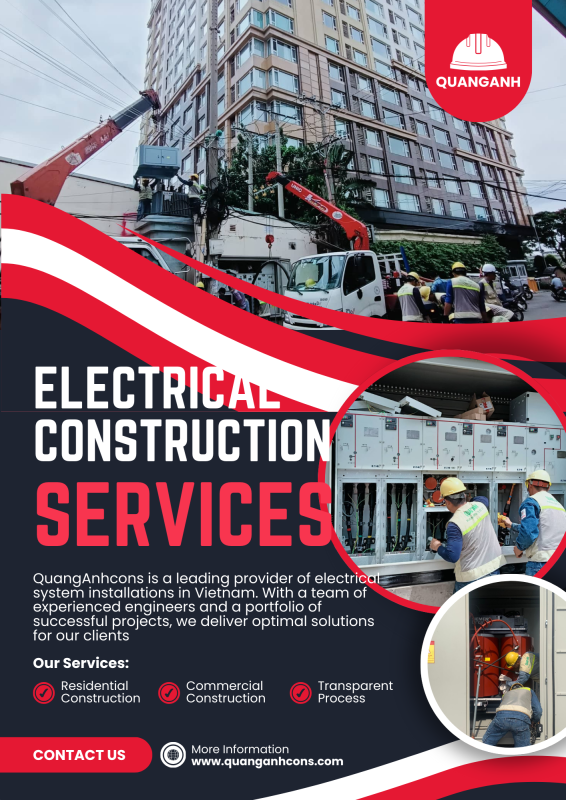
As Vietnam’s industrial and urban sectors continue to grow, the need for reliable electrical system installations has surged. Ensuring these systems are installed safely and efficiently requires adherence to a detailed and professional process that complies with stringent standards.
I. Steps in the Electrical System Installation Process
1. Survey
- Site Survey: Evaluate the terrain, environmental conditions, and other influencing factors.
- Needs Assessment: Collect data on the project’s electrical requirements.
2. Design
- Design Drawings: Engineers create design plans based on survey findings.
- Design Approval: These plans must be approved by relevant authorities.
3. Construction
- Material and Equipment Preparation: Procure and inspect all electrical equipment.
- System Installation: Execute the installation according to the approved design.
- Construction Supervision: Monitor construction to ensure compliance with safety and quality standards.
4. Inspection and Maintenance
- System Inspection: Conduct thorough testing and checks before the system goes live.
- Regular Maintenance: Schedule and perform regular maintenance to maintain optimal performance.
II. Electrical Grid Model in Vietnam and Safety Standards
II.1. Vietnam’s Electrical Grid Model
Vietnam’s electrical infrastructure integrates power plants, grids, and consumers, ensuring efficient production, transmission, distribution, and consumption of electricity. The system operates at various voltage levels: 500kV, 220kV, 110kV, 35kV, 22kV, 10kV, 6kV, and 0.4kV, with a frequency of 50 Hz. Typical phase and wire structures include 3-phase, 2-phase, and 1-phase systems.
- Power Plants:
- Facilities generating electricity from diverse energy sources such as thermal, hydro, and nuclear power.
- Electrical Grids:
- System Grid: Connects power plants and regional load nodes, operating at 500 kV.
- Transmission Grid: Extends from regional intermediate substations to high-voltage busbars, supplying local intermediate substations (110-220 kV).
- Distribution Grid: Links local intermediate substations to load substations, including medium voltage distribution (6-35kV) and low voltage distribution (220-380V).
II.2. Common Electrical Systems
Voltage levels in Vietnam are categorized as follows:
- Low Voltage System:
- Used in residential and small industrial applications.
- Voltage below 1kV, typically ranging from 220V to 380V.
- Medium Voltage System:
- Suitable for industrial and large infrastructure applications.
- Voltage ranges from 1kV to 35kV, with 22kV being the most common.
- High Voltage System:
- Applied in power plants and extensive transmission networks.
- Voltage ranges from 35kV to 220kV.
- Ultra High Voltage System:
- Employed for long-distance transmission and large-scale projects.
- Voltage exceeds 220kV.
II.3. Safety Standards and Regulations
Compliance with national and international safety standards, such as IEC and TCVN, is mandatory for electrical system installations. These standards cover labor safety, equipment safety, and environmental safety.
- Safety Distances for Different Voltage Levels:
- Low Voltage: 0.3m
- 1kV to 15kV: 0.7m
- 15kV to 35kV: 1.00m
- 35kV to 110kV: 1.50m
- 110kV to 220kV: 2.50m
- 220kV to 500kV: 4.50m
Following a structured installation process and adhering to safety standards ensures the efficiency and safety of electrical systems. Selecting a reputable contractor is crucial for achieving high-quality installations.
Quang Anh CE Co., LTD is a leading provider of electrical system installations in Vietnam. With a team of experienced engineers and a portfolio of successful projects, we deliver optimal solutions for our clients. Contact us for expert consultation and detailed quotations.
Quang Anh CE Co., LTD
Office: Unit 02, 8th Floor, Pearl Plaza Building, 561A Dien Bien Phu Street, Ward 25, Binh Thanh District, Ho Chi Minh City, Vietnam
Hotline: 0919758191
Website: Quang Anh CE Co., LTD
Quick substation quotation
Loading the tool…
Multi-station and feeder project
Loading the tool…
Related Posts
Parallel Transformer Operation: Preconditions Before Closing the Factory Bus Tie
Review ratio, vector group, impedance, load sharing, fault level, neutral, protection and synchronism before a [...]
22 kV Cable Feeder Ampacity: Build the Route Data Pack Before Selecting Size
Turn a 22 kV factory feeder route into an auditable ampacity model covering load, soil, [...]
Factory Electrical Outage Data: From Event Logs to Continuity Decisions
Build a decision-grade factory outage data pack that separates evidence from inference, quantifies restoration stages [...]
Phased EV Depot Rollout: Power-Ready Bays vs Commissioned Chargers
Stage a fleet-charging depot by separating reserved, civil-ready, power-ready and commissioned bays, with controlled capacity, [...]
BESS Warranty Exclusions: An Industrial Buyer’s Contract Review for Vietnam
Review BESS warranty exclusions against the factory duty cycle, AC test boundary, site conditions, data [...]
Self-Funded or Third-Party Rooftop Solar? A Vietnam Factory Proposal Comparison
Compare self-funded and provider-funded rooftop solar proposals on the same energy boundary, legal structure, risk [...]
Condition-Based or Calendar-Based Electrical Maintenance? A Factory Scope Decision Guide
A buyer-side method for choosing calendar, usage and condition-based electrical maintenance using failure modes, auditable [...]
What a Factory Power-Redundancy Claim Must Prove Before an Owner Accepts It
A factory owner’s evidence checklist for power-redundancy claims: source independence, surviving load, transfer logic, protection, [...]
Energy-Savings Proposals: Compare Baselines Before Comparing Percent Savings
Compare factory energy-saving proposals on one auditable baseline: align boundaries, production adjustments, reporting periods, meter [...]
Fleet Operating Data Before EV Charging-Site Sizing: An Owner’s Input Pack
Build a defensible fleet-charging input pack from routes, arrival and departure times, energy, vehicle acceptance, [...]
BESS Duty-Cycle Assumptions: An Owner’s Audit for Vietnam Factories
Audit BESS duty-cycle assumptions for a Vietnam factory: services, SOC reserve, power-duration, efficiency, throughput, degradation, [...]
Rooftop Solar Investment Assumptions: A Finance-Team Challenge List for Vietnam Factories
Audit rooftop-solar investment assumptions for a Vietnam factory: load matching, yield, losses, availability, degradation, cash-flow [...]
Material Traceability for Factory Electrical Packages: Records an FDI Owner Can Audit
Define auditable material traceability for factory electrical packages: serial and batch links, receipt and quarantine, [...]
Electrical EPC Training Deliverables: An Owner’s Contract Guide
Define electrical EPC training by role, task, revision, safety boundary and acceptance evidence. Includes an [...]
Electrical Single Points of Failure: Rank the Production Consequence
Build a factory electrical consequence register around functions, shared dependencies and credible recovery paths. Compare [...]
Shared BESS for Factory Tenants: Separate Control from Energy Allocation
Define shared BESS electrical, command and tenant allocation boundaries before procurement, with a checked common-meter [...]
Electrical Handover Dossier: Make It Usable for an Overseas Facility Team
Specify an electrical handover dossier that an overseas facility team can actually use: asset links, [...]
Switchboard FAT Report Review: Evidence Before Dispatch
Review the switchboard FAT evidence chain before dispatch: assembly identity, drawing revisions, verification records, actual [...]
Factory Substation Delivery: Prove the Access Route Before Dispatch
Build a route evidence pack before dispatching factory electrical equipment: shipping envelopes, access constraints, receiving [...]
Owner-Supplied Electrical Equipment: Custody and Acceptance for a Vietnam Factory
Agree receipt, custody, preservation, technical release and operational acceptance when a factory owner buys electrical [...]