

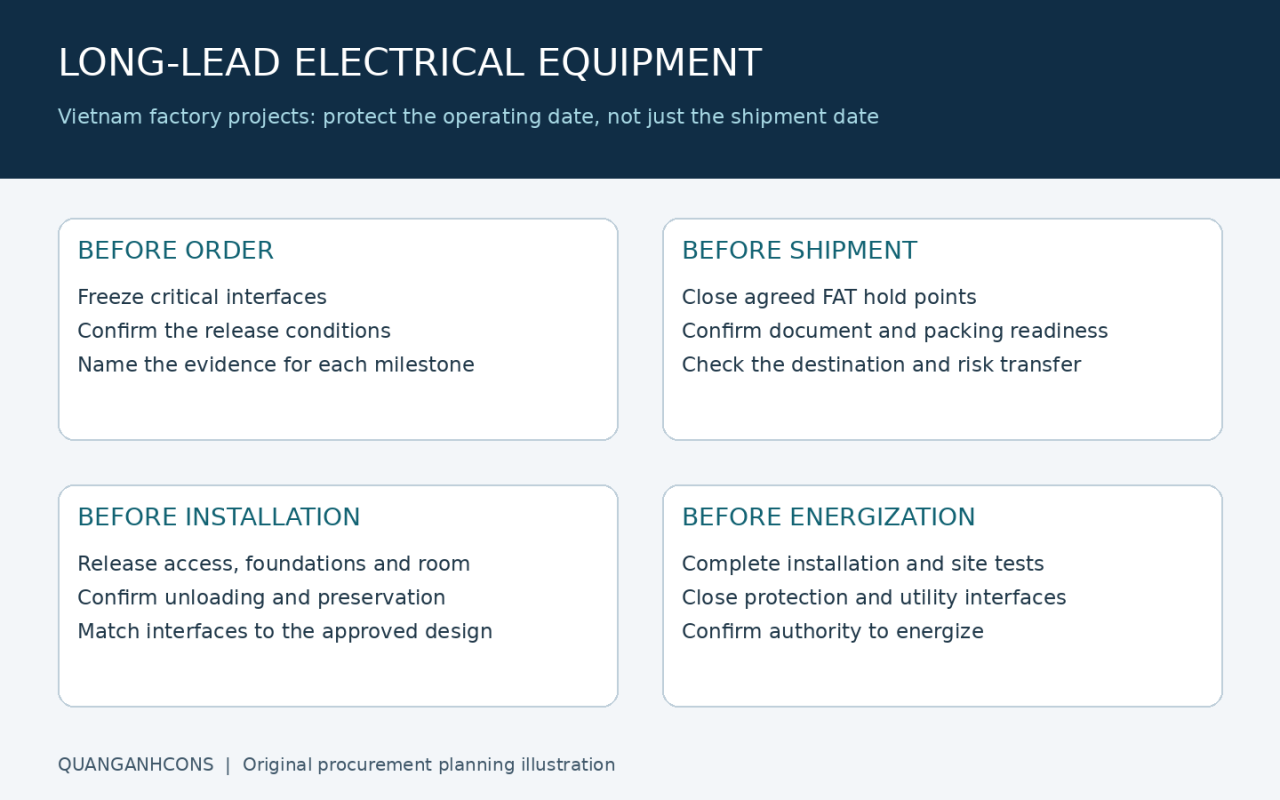
Long-lead electrical equipment needs a plan that works backwards from the date the factory needs usable power. A supplier’s shipment promise is only one milestone. Design release, factory testing, transport, site access, installation and authorization to energize must also fit the plan. For an FDI factory in Vietnam, the practical decision is which commitments to make early, and which uncertainties the team must resolve before manufacturing starts.
Prepared for QuangAnhcons · Editorial focus: Electrical procurement and project delivery · Sources checked: 6 October 2026.
This guide gives owners and EPC procurement teams a release checklist, a backward-planning example and an RFQ structure. It does not quote current equipment lead times or prescribe a statutory approval timetable. Obtain those inputs for the actual supplier, equipment configuration, site and electricity-supply arrangement.
1. Define the milestone you are buying
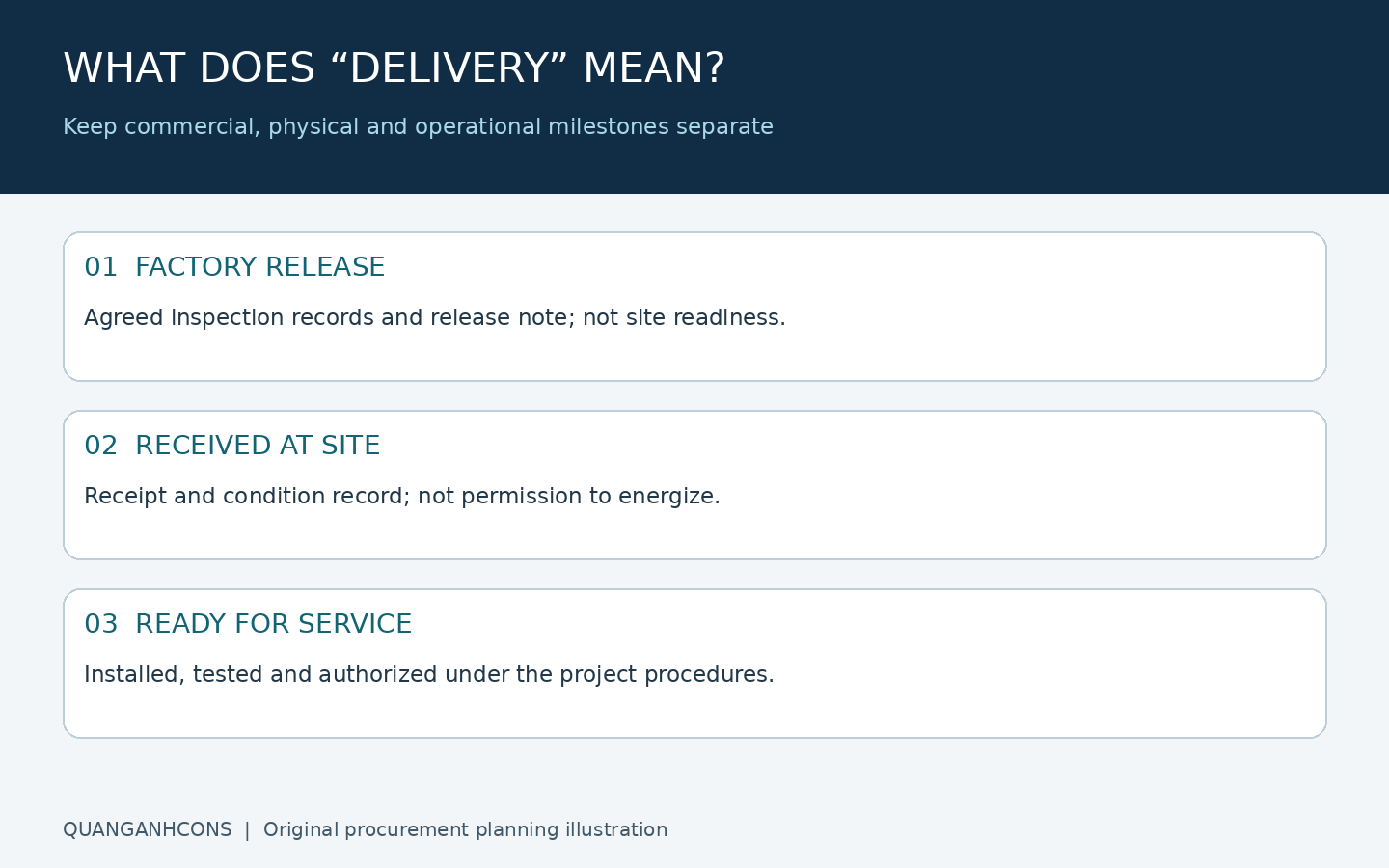
Start by replacing the word “delivery” with a precise event. Is the supplier promising readiness for inspection, dispatch from its factory, arrival at a port, unloading at the site, or an installed system? These events require different evidence. A schedule can look healthy while the factory opening remains exposed if procurement tracks dispatch and the owner expects energized equipment.
The GAO Schedule Assessment Guide, GAO-16-89G, published in December 2015 explains why an integrated schedule should connect the activities leading to major events and make the effects of change visible. Here we apply that principle as a planning method, not as a Vietnamese regulatory requirement.
| Milestone | Evidence to agree | What it does not prove |
|---|---|---|
| Released for manufacture | Approved technical baseline, closed release conditions and written authorization | That future design changes are free or harmless |
| Factory acceptance complete | Agreed FAT records, disposition of outstanding items and release decision | That site tests or utility interfaces are complete |
| Received at site | Receipt, condition report, packing list and storage handover | That the equipment is installed or operational |
| Ready for energization | Project-specific installation, test and authorization records | That every production process is ready for commercial operation |
Therefore, for each purchase order, name one contractual delivery event and then retain the additional project milestones in the integrated programme. Ask the supplier to identify what starts its lead-time clock. An order date, advance payment, approved drawing and production release are not interchangeable starting points.
2. Decide what can be released early
Do not classify equipment as long lead solely because it is large or expensive. Ask whether its confirmed supply sequence leaves enough time before the date it is needed. A small specialist protection device can control completion if it has no approved substitute. Conversely, a large item with a confirmed, compatible production slot may have adequate margin.
For example, transformers, medium-voltage switchgear, main low-voltage assemblies, generators and control packages are candidates for early review. This is a screening list, not a claim about their current availability. Obtain a dated response for the exact configuration and identify subcomponents that can constrain the assembly.
For electrical equipment, establish a release baseline that covers ratings, the approved single-line diagram, protection and metering interfaces, cable entries, dimensions, access clearances and environmental conditions. The design team should identify which details truly affect manufacture. A procurement team should not fill engineering gaps by accepting a supplier’s default configuration without review.
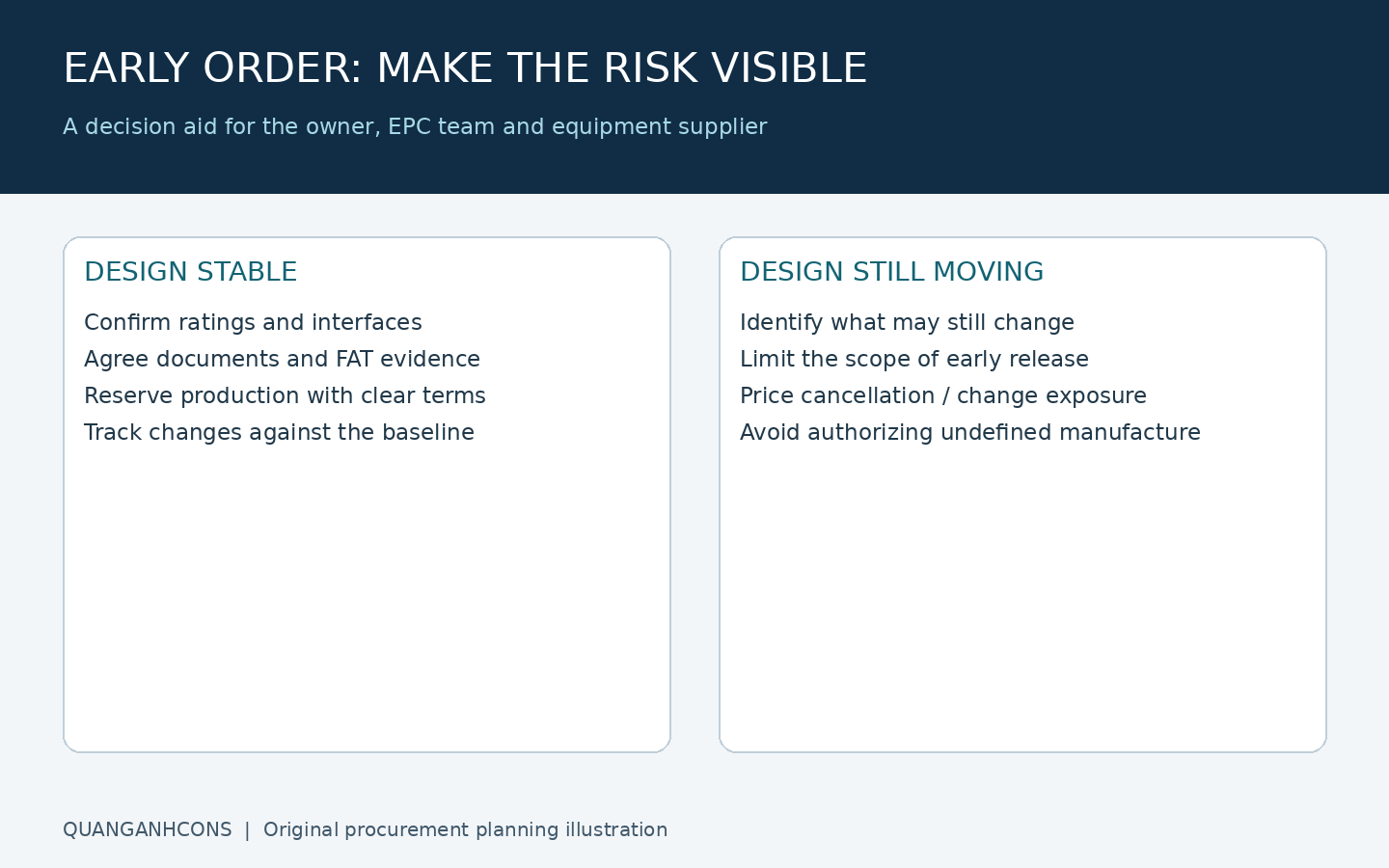
Compare three commitment options
- Full release after design freeze: appropriate when critical interfaces are settled. It limits avoidable rework but may require earlier design decisions.
- Limited early release: useful when a defined, stable portion can proceed. Specify exactly what the supplier may manufacture and what remains on hold.
- Capacity reservation: may protect a production opportunity while design develops, if the supplier offers it. Confirm the expiry, payment, cancellation and conversion conditions in writing.
The fastest apparent option can become the slowest if later changes affect the enclosure, busbar arrangement, protection interfaces or shipment dimensions. Therefore, record the owner’s reason for early commitment and the financial exposure the owner accepts. Reservation is not proof that a finished unit will meet the intended specification.
3. Build the backward schedule for long-lead electrical equipment
Use the required operating date as the endpoint. Work backwards through the activities that genuinely depend on one another. Run civil works, utility coordination and procurement in parallel only where the interfaces allow it. Do not conceal a real activity inside an unexplained waiting period.
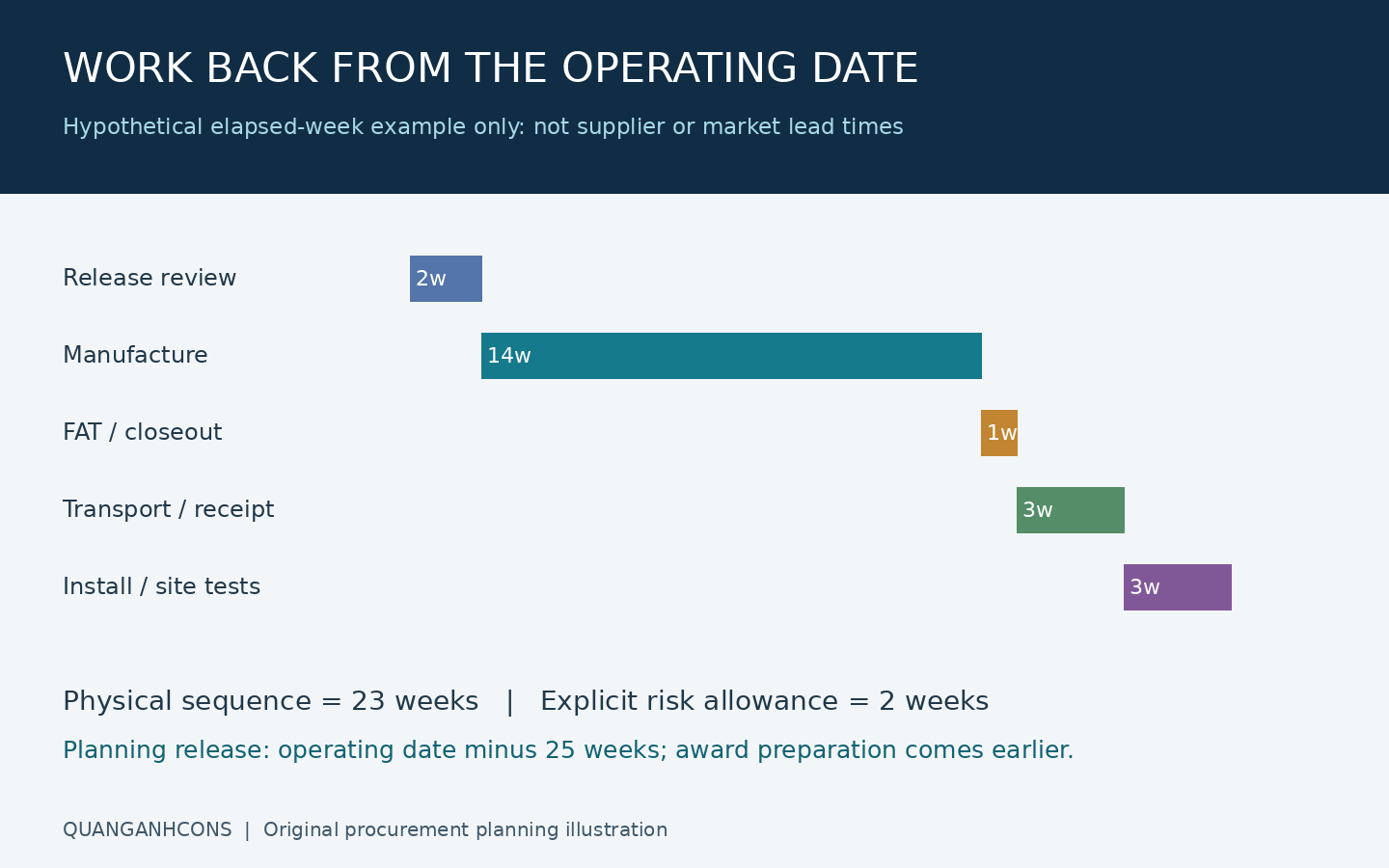
Hypothetical example: the following durations are invented solely to demonstrate the method. They are elapsed weeks, not supplier quotations, market benchmarks or forecasts for a Vietnam project. The example assumes a sequential equipment path and no calendar interruptions.
| Activity after release starts | Assumed duration | Completion from start |
|---|---|---|
| Final release review | 2 weeks | Week 2 |
| Manufacture | 14 weeks | Week 16 |
| FAT and agreed closeout | 1 week | Week 17 |
| Transport and receipt | 3 weeks | Week 20 |
| Installation and site tests | 3 weeks | Week 23 |
The physical sequence is 2 + 14 + 1 + 3 + 3 = 23 weeks. Adding an explicit, hypothetical two-week risk allowance gives a planning interval of 25 weeks. Thus, the release process must begin no later than the operating date minus 25 weeks under these assumptions. Tender evaluation, commercial approval and any earlier design development need their own activities before that start.
Test the schedule when a duration changes
Now test a change. If manufacturing grows from 14 to 17 weeks, the physical sequence becomes 26 weeks. Keeping the same two-week allowance moves the required release start three weeks earlier. If the start cannot move, the former 25-week interval is one week short even after consuming all of its allowance. That is a management decision, not a reason to relabel the allowance as achieved progress.
Next, repeat the calculation using the supplier’s evidence and the project calendar. Include shutdown windows, inspections, working-day conventions and known non-working periods explicitly. Where site readiness follows another path, the usable start of installation is the later of equipment availability and the site’s verified readiness. Review both paths whenever either one changes.
4. Connect delivery to site readiness in Vietnam
For an international owner, the key local interface is often the boundary between the factory project, the industrial-park infrastructure provider and the electricity supplier. Confirm who provides power at the agreed boundary and who coordinates each connection activity. A purchase order for equipment does not establish that connection arrangement. Use the project’s actual agreement and current instructions from the relevant parties.
In parallel, ask the site team to release practical prerequisites before booking delivery: access route, vehicle and unloading arrangements, foundation or room readiness, lifting responsibility, storage and preservation. For a brownfield factory, also confirm the permitted outage window and how the existing installation will remain available until the approved changeover. None of these dates should be inferred from equipment shipment.
Separate the logistics term from the project completion promise
The ICC Academy explanation of delivery and risk transfer, dated 31 July 2025, distinguishes delivery under an Incoterms® rule from arrival at the destination. Specify the chosen rule, edition and named place or point precisely. Have the commercial and logistics teams confirm that the selected arrangement works for the actual transaction.
The International Trade Administration’s Incoterms overview also explains that these rules do not settle every contract issue, including payment timing, ownership transfer or liability for delayed delivery. Keep commissioning obligations and remedies in the relevant contract provisions; do not expect a transport abbreviation to define them.
As a project control measure, require a pre-dispatch check of packing information, destination details, receipt responsibilities and the documents the importer or broker has requested. These are coordination recommendations, not a statement of Vietnamese customs requirements or a guarantee of clearance time.
5. Recover a slipping package without hiding risk
When a milestone slips, first identify the constraint. Is the supplier waiting for a technical decision, a component, a test slot, transport booking or permission to dispatch? A request to “expedite everything” often produces reassurance without a usable recovery plan. Ask for the affected activity, its evidence, the revised forecast and the next decision deadline.
Consider a hypothetical switchboard whose enclosure is ready but whose specified protection device is delayed. Shipping an incomplete board might advance installation, but it creates additional site work and another acceptance boundary. Compare the revised completion date, site resources, test implications, warranty conditions and responsibility for completing the assembly. Do not treat partial shipment as recovery unless it improves the date of usable power.
However, an alternative device may help only after the design team confirms the relevant compatibility and performance requirements. The same brand or nominal current is not sufficient evidence of interchangeability. Record the approved change, revised documents and consequences for testing before release. Where evidence is incomplete, keep the proposal as an option rather than presenting it as an approved solution.
| Option | Potential benefit | Condition before acceptance |
|---|---|---|
| Earlier owner decision | Removes a documented release constraint | Technical inputs are complete enough to make the decision responsibly |
| Partial shipment | Allows genuinely independent installation work | Scope split, preservation, completion and testing responsibilities are agreed |
| Approved substitution | May improve availability | Design review and supplier evidence confirm suitability; cost and schedule impacts are accepted |
| Resequenced site work | Uses available resources productively | The new sequence preserves access, safety and final testing requirements |
Similarly, temporary supply requires its own engineered scope and approvals. It is not a generic procurement workaround. Compare any recovery cost against its credible schedule benefit, and retain the original baseline alongside the revised forecast so the change remains visible.
6. Use a milestone-based RFQ and control register
Issue the same milestone questions to every bidder. Comparable answers are more useful than a single “delivery: X weeks” line with undisclosed assumptions. The following RFQ wording is a starting point for project review, not a substitute for the final commercial and technical contract.
Please provide a dated programme for the specified equipment configuration. Identify the event that starts each duration; all owner inputs required for release; drawing review periods; manufacturing, FAT and closeout milestones; the delivery term, edition and named place; site receipt assumptions; and the support required for installation and site testing. State quotation validity, production-slot conditions, exclusions and the effect of technical changes. Identify any unconfirmed dates and the evidence needed to confirm them.
Keep the forecast separate from actual progress
Then maintain one register with a line per package and a separate owner for every unresolved input. Record the baseline date, current forecast, evidence date, next action and decision deadline. Keep “supplier forecast”, “contractual commitment” and “actual completion” as different fields. A dated photograph or progress percentage alone does not establish completion of a contractual milestone.
- Before award: compare the same configuration, delivery event and scope; identify exclusions and conditional dates.
- Before manufacture: close the release checklist and preserve the approved revision.
- Before FAT: agree the applicable test plan, attendance, records and handling of outstanding items. FAT means factory acceptance testing; the actual scope is project and equipment specific.
- Before dispatch: confirm release evidence, logistics and site readiness together.
- Before energization: verify that installation, site testing and the project’s authorization process are complete.
For related interfaces, see our electrical design responsibility guide and utility connection responsibility guide. These help identify who provides the inputs; this article addresses when those inputs and equipment must be ready.
QuangAnhcons project reference
Watch the QuangAnhcons archive video: Energizing the 2500KVA substation, providing strong electrical power for the factory – Vietnam FDI. This video is linked from the company’s Long Hau project page. It provides related substation context, not evidence for the hypothetical durations or a delivery guarantee in this guide. Video remains on YouTube.
Prepare your package review
Send QuangAnhcons the site location, load schedule, current single-line diagram, equipment list, interface drawings and target operating date. Include supplier quotations and their release conditions where available. Request a scope review that identifies missing inputs, package boundaries and the evidence needed to build a credible procurement programme.
Sources and method
Sources were checked on 6 October 2026: the GAO-16-89G public overview for integrated schedule principles; ICC Academy’s July 2025 explanation for delivery and risk terminology; the International Trade Administration overview for the limits of Incoterms; and the QuangAnhcons project page for the company-published video reference. Links appear beside the relevant statements above.
We developed the release checklist, RFQ, recovery comparison and numerical example as editorial planning tools for this guide. Independent arithmetic checks confirmed the calculations. No live supplier quotation, Vietnam market lead-time survey, licensed standard clause or project completion record is asserted. Confirm project-specific technical, contractual and local requirements with the responsible parties before commitment.
Related Posts
Long-Lead Electrical Equipment: Plan a Vietnam Factory Schedule
Plan long-lead electrical equipment for a Vietnam factory with release milestones, a backward schedule, site [...]
Oct
Who Owns Each Electrical Design Deliverable? A Responsibility Matrix for FDI Factories
Build an electrical design responsibility matrix for a Vietnam factory. Assign inputs, checks and approvals [...]
Oct
Before Leasing a Factory in Vietnam: Verify the Electrical Supply
Verify capacity, condition and landlord–tenant boundaries before leasing a factory in Vietnam. Use an evidence [...]
Oct
What Are You Really Buying in an Electrical EPC Tender?
Compare electrical EPC tender offers fairly. Use a scope matrix, worked bid example, RFQ wording [...]
Oct
Who Owns the Utility Connection? Responsibilities in a Vietnam Factory EPC Project
A decision guide for FDI factory owners in Vietnam: divide utility connection responsibilities among the [...]
May
Professional Electrical System Installation Process in Vietnam
As Vietnam’s industrial and urban sectors continue to grow, the need for reliable electrical system [...]
Aug
Find the Best Electrical Contractor Near Me – Your Reliable Partner
Finding a dependable electrical contractor near you is crucial for ensuring the safety and efficiency [...]
Jul
Top Vietnam Electrical Contractor Near You – QuangAnhcons
Finding a reliable electrical contractor is crucial for ensuring the safety and efficiency of your [...]
Jul
Top Vietnam Electrical Contractor Services – Choose QuangAnhcons
When it comes to ensuring the electrical safety and efficiency of your industrial facilities, finding [...]
Jul
Expert MEP Engineering for Industrial Buildings – QuangAnhcons
Efficient MEP (Mechanical, Electrical, and Plumbing) engineering is crucial for the optimal performance of industrial [...]
Jul
Trusted Electrical Contractors – Your Partner in Industrial MEP Solutions
In the rapidly evolving industrial sector, finding reliable MEP contractors is crucial. QuangAnhcons stands out [...]
Jul
MEP Construction Services for Factories – Comprehensive Solutions for Businesses
In the context of modern industry, MEP (Mechanical, Electrical, and Plumbing) construction services for factories [...]
Jul
Top-Notch Industrial Electrical Installation Services
Ensuring the optimal functioning of electrical systems in industrial settings is crucial for operational efficiency [...]
Jul
Professional Low Voltage Electrical Cable Installation and Cable Tray Construction – Enhancing Safety and Aesthetics
Upgrading your electrical systems is crucial for ensuring safety, efficiency, and aesthetics in any industrial [...]
Jul
Top-Quality M&E Construction Services – QuangAnhcons Vietnam
Professional M&E Construction Services – QuangAnhcons QuangAnhcons stands as a premier contractor in the Mechanical [...]
Jul