

A factory procurement team receives two offers for an electrical EPC tender. Both list a transformer, medium-voltage equipment and a main switchboard. The cheaper offer looks attractive—until the clarification meeting reveals that the trench, third-party testing and work during the production shutdown are outside its price. The bidders priced different jobs.
A useful electrical EPC tender starts with one agreed boundary: what the owner needs to operate, which party delivers each interface, and what evidence makes the work complete. Equipment ratings matter, but they cannot settle responsibility for a cable crossing, machine termination or an energisation dependency. Put those decisions into the RFQ before comparing prices.
This guide is for factory owners, FDI project teams and procurement managers preparing a project in Vietnam. It provides an editable responsibility matrix, a worked bid comparison and wording you can adapt for an RFQ. The allocation is a procurement discussion template; the actual contract, utility arrangements and approved project documents determine the duties.
Give bidders a brief they can design around
Before issuing an electrical EPC tender, start with what production must do, rather than a transformer size copied from an early budget. A machine list is useful only when the bidder can distinguish installed ratings from the load that is likely to run together. A machine supplier also needs to identify starting behaviour, power factor or other relevant characteristics—not leave the EPC bidder to guess them.
Schneider Electric’s Electrical Installation Guide discusses assessing actual maximum demand with operating modes, utilisation and non-simultaneous use. Its practical lesson for procurement is straightforward: ask for the assumptions behind the proposed supply capacity. Do not impose one diversity factor or one spare-capacity percentage across every factory.
| Input | What to record | Who closes a missing item? |
|---|---|---|
| Production loads | Equipment tag, electrical input data, operating combinations, starting requirements and criticality. | Owner and machinery supplier; designer reviews the basis. |
| Supply information | Proposed connection point, available project information, metering/interface arrangements and open dependencies. | Named owner coordinator with the relevant utility or landlord. |
| Site conditions | Route plan, access, underground-service information, civil constraints and existing drawings where available. | Owner/project manager; survey scope allocated explicitly. |
| Operating objective | Target production date, permitted outage periods, loads requiring continuity and agreed future expansion scenario. | Owner’s operations representative. |
| Document baseline | Issued drawing revisions, specification, quantity schedule and a register of provisional information. | Tender administrator. |
An unknown item need not stop the RFQ. It does need a visible status, an assumption for pricing and a deadline for confirmation. For example, a provisional cable route can be priced against a stated length, with the measurement and change mechanism agreed in the commercial schedule. Calling the quantity “estimated” without saying how it will be settled leaves the same dispute waiting for construction.
Draw the electrical EPC tender boundary from supply to machine
A single-line diagram shows how power is distributed; a boundary drawing shows who does the work. Use both. Mark the connection point, route, substation, main and downstream boards, and the agreed machine connection points. Give each hand-off a tag that appears in the scope schedule. Include the civil and controls interfaces on companion drawings when the electrical diagram cannot show them clearly.

“Up to the machine” is too vague to price. Does it mean a cable left beside the machine, terminated at the isolator, or connected and tested with the machinery supplier present? The difference affects cable length, labour, the outage sequence and acceptance records. Likewise, “complete substation” does not automatically settle road crossing, drainage, foundation, unloading or the incoming supply interface.
For an international owner, the tender documents may pass between a global procurement team and a local delivery team. State the controlling document language and how translated documents or conflicting revisions will be resolved. That is a project decision to agree, rather than a standard rule assumed in this guide.
Assign a deliverable to every responsibility
In an electrical EPC tender, a name in a responsibility column is not enough. Pair it with an output another party can use and the evidence that will close the interface. “Civil by others” becomes useful only when it identifies who issues foundation loads, who checks openings, and what must be ready before equipment arrives.
| Interface | Decision to allocate | Concrete deliverable | Acceptance evidence to agree |
|---|---|---|---|
| Supply / landlord | Who obtains information, prepares submissions and tracks external dependencies? | Interface register, submission list and written project assumptions. | Recorded responses and an agreed connection boundary; identify unresolved dependencies. |
| Civil and cable route | Who surveys, designs, constructs and reinstates? | Coordinated route; foundation/load/opening data; measured quantities. | Agreed inspection records and concealed-work checks before covering. |
| Transformer / MV assembly | Who supplies, transports, unloads, installs and tests each item? | Equipment schedule, approved submissions, installation and lifting interfaces. | Equipment identity, agreed inspection/test records and resolved installation defects. |
| LV and machine ends | Exactly where does each feeder and termination responsibility finish? | Tagged boundary drawing and termination schedule. | Inspection and test records for the defined feeder and agreed connection point. |
| Controls / monitoring | Who provides devices, wiring, signal mapping, configuration and integration? | Signal list, protocol/interface details and access arrangements. | Agreed functional demonstration and usable configuration records. |
| Shutdown / temporary supply | Who approves the window, isolates, provides continuity and authorises restoration? | Coordinated work sequence and owner-approved decision points. | Readiness review and the project’s authorised work/release records. |
| Handover / support | Who compiles, checks and accepts records; who answers after handover? | Handover index, training plan and warranty/support register. | Accepted files, recorded training and a defined outstanding-items list. |
Keep the owner, designer, civil contractor, EPC contractor and machinery supplier in the same review for the interfaces that cross their packages. Otherwise, a question can be “closed” in the electrical tender while remaining unanswered in the civil contract. One owner-side coordinator should maintain the combined register and record the decision—not make technical decisions beyond their authority.
Write the three tender clauses that prevent ambiguity
The following wording is an editable starting point for your electrical EPC tender and contract review. Replace the brackets, identify the actual documents and make sure the final contract does not contradict the schedule.
1. Fix the pricing baseline
“The base offer shall address the scope shown in [boundary drawing and revision] and the requirements in [specification and revision]. Return a marked boundary drawing, priced quantity schedule and one consolidated deviations/exclusions schedule. Each deviation shall identify its document reference and effect on scope, price or programme. Alternative proposals shall be separate from the base offer.”
This lets the owner distinguish a compliant base offer from a useful alternative. A different transformer arrangement may be worth considering; it should not quietly replace the requested basis and make the commercial comparison meaningless.
2. Make a provisional interface measurable
“The base price assumes [route / quantity / condition]. [Named party] will confirm the final information by [date or decision milestone]. The offer shall state the measurement basis, rates or agreed method for evaluating a change, including related installation and reinstatement work.”
A per-metre cable rate alone may not cover a different route, crossing method or installation condition. Ask how the bidder will price those changes before the assumptions are removed from the offer.
3. Define the evidence for completion
“Submit the proposed inspection, testing and handover deliverables against the package scope. Identify witnesses, prerequisites and dependencies on other parties. Delivery, installation completion, readiness for energisation and operational handover shall be separate milestones, with the evidence for each agreed before award.”
A promised delivery date does not demonstrate that the site can be energised that day. The milestone schedule must show the information, access, reviews and third-party actions that make the next step possible.
Compare electrical EPC tender offers on the same basis
Read the exclusions before debating the discount. The example below deliberately uses invented numbers to show the method. It is not a QuangAnhcons quotation, a Vietnam market price or a forecast. All values are USD, excluding VAT; both offers are assumed to meet the same specified performance and quantities.
| Comparison item | Bid A | Bid B | Basis used in this example |
|---|---|---|---|
| Base offer | 120,000 | 128,000 | Same electrical performance and quantity baseline. |
| Civil reinstatement | Excluded: add 9,000 | Included | Illustrative owner estimate for the excluded scope. |
| Agreed third-party tests | Excluded: add 3,000 | Included | Same illustrative test scope; no test voltage is specified here. |
| Defined shutdown working arrangement | Excluded: add 2,000 | Included | Same agreed operating-factory work window. |
| Comparable total | 134,000 | 128,000 | No contingency, finance cost or tax added in this simple example. |
The arithmetic is: A = 120,000 + 9,000 + 3,000 + 2,000 = 134,000. A begins 8,000 below B but becomes 6,000 above it on the assumed common basis. The conclusion is not “choose B automatically.” It is “resolve the three exclusions and validate the added costs before using the base-price ranking.”

In a live comparison, obtain a priced clarification or a defensible estimate for each exclusion. Leave an unresolved amount visible rather than inventing precision. Keep performance deviations in a separate technical assessment; adding a sum of money cannot turn an unsuitable design into a compliant one.
For cross-border procurement, put currency, quotation date, validity, payment assumptions and the treatment of exchange-rate exposure in the comparison. Identify VAT and other tax treatment, import or delivery responsibilities and any items priced in another currency. Use the project’s actual commercial and tax advice; this guide does not prescribe a tax rate. Compare the schedule assumptions too: a low offer that depends on an unavailable shutdown window is not the same delivery proposal.
Prepare an operating factory for the work window
For a brownfield factory, the electrical EPC tender must account for work that competes with production for access and time. An outage request should explain which operations are affected, what work will be completed, how the site returns to operation and who can stop the job if the readiness conditions are not met. “Weekend shutdown” is a date range, not a plan.

Before releasing the window, review availability of materials and personnel, approved work documents, site access, required permits and planned test resources. Agree a go/no-go decision point early enough for production to respond. If temporary power is required, allocate its design, supply, fuel or energy needs, operation and acceptance; do not treat a generator on a list as a complete continuity solution.
Ask the delivery team to identify the last safe decision point for recovery if work runs late. The owner’s operations team needs to understand the consequence, while the authorised technical team establishes what restoration is permissible. This is especially important when machinery vendors or other contractors must be present at the final connection.
For a new factory, the equivalent concern is readiness across packages: civil access, room/enclosure conditions, cable routes, machinery arrival and the external supply interface. Tie the programme to those dependencies instead of relying on a single target energisation date.
Define handover and support before award
The installation can look finished while the owner still lacks the files needed to operate it. Specify a handover index in the electrical EPC tender, then agree the detailed records as the design and test plan develop. An as-built drawing should reflect what was installed; a folder of tender drawings with a different cover is not the same deliverable.

- Design and installed condition: controlled as-built drawings, equipment/feeder identities and relevant approved design records.
- Verification: the agreed inspection and test records, equipment documentation and closed or accepted outstanding items.
- Operation: manuals, settings and configuration records where relevant, training evidence and agreed access credentials.
- Support: warranty start and boundary, responsible contact, response arrangements, maintenance scope, spare-parts responsibilities and exclusions.
Clarify who receives editable files, software access or configuration backups when these are part of the package. Also identify who maintains the installation after handover. Supplying a manual does not mean a maintenance service is included, and a warranty promise does not settle the cost of every site visit. Record these commitments in the commercial documents while both parties can still align them with the price.
Build an electrical EPC tender pack that bidders can use
A practical pack can be compact as long as the documents agree with one another. Issue a numbered document register, keep one revision baseline and send clarification answers to all bidders through the agreed tender process. Otherwise the best scope matrix will still produce offers based on different information.
- Operating brief: production requirements, load data, continuity needs and open technical inputs.
- Boundary drawings: power distribution and tagged hand-offs, including civil and controls interfaces.
- Performance specification: required functions and evidence, plus the process for proposed equivalents.
- Quantity schedule: measured and provisional quantities distinguished, with the settlement method stated.
- Responsibility and exclusion schedules: one place to see duties, deliverables and qualifications.
- Milestone and acceptance schedule: dependencies, witnesses, evidence and owner decisions.
- Commercial return template: currency, tax basis, validity, payment and identified provisional/optional items.
- Clarification register: question, document reference, responsible party, answer and closure date.
Five questions to settle before award
- Which three interfaces could stop energisation even if the electrical equipment arrives on time?
- Does every cable end have a named supply, installation, termination and testing responsibility?
- Which quantities or site conditions remain provisional, and who confirms them?
- What must be ready before the owner releases the production work window?
- What evidence must the owner receive before accepting the next milestone?
Use the answers to direct the final clarification meeting. Do not reopen every minor wording issue at once; first resolve the omissions that change safety, operating continuity, acceptance, price or the critical path.
Questions that usually arise in clarification
Does “turnkey electrical EPC” mean everything is included?
The label alone does not define a reliable pricing boundary. An electrical EPC tender needs marked drawings, scope, exclusions, responsibilities and acceptance deliverables. The agreed contract should make those documents consistent.
Should every bidder propose exactly the same equipment?
Not necessarily. A performance-based tender can allow alternatives, but request a comparable base proposal and identify how each alternative meets the requirements. Where specific equipment is required, state it and define the approval process for any equivalent; a shared rating or brand category is not evidence of equivalence.
Can an RFQ proceed before all machinery data is available?
It can proceed on identified provisional information if the owner accepts the resulting uncertainty. Ask bidders to list the assumptions that affect capacity, quantities, timing and price. Set a confirmation milestone before the missing inputs cause an irreversible purchase or design decision.
How is the final energisation date agreed?
Start from the target operating date and work backwards through the project’s actual dependencies. The delivery team must separate equipment lead times from site readiness, reviews, testing and external actions. An indicative programme should show which dates depend on information or actions outside the bidder’s control.
Bring the scope into a project discussion
The value of a tender is the conversation it makes possible: the owner can see what is being bought, the delivery team can price it, and the operating team can explain what completion must mean. That is a stronger starting point than trying to repair a scope gap after equipment has already been ordered.
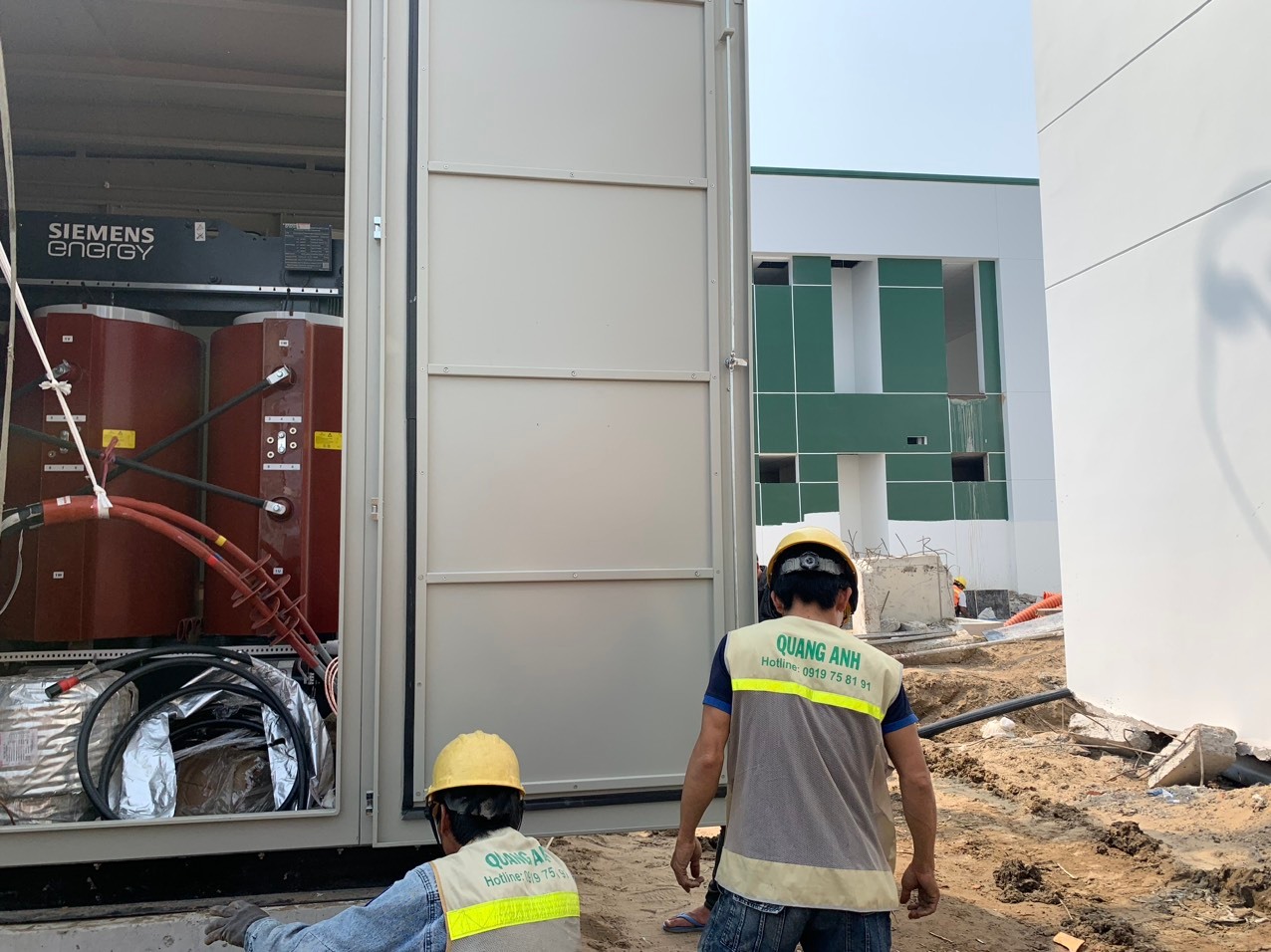
Project video linked by QuangAnhcons in its Long Hau case. It is included as company project context, without attributing test results, contract boundaries or the worked price example to the pictured works. Watch the linked project video on YouTube.
For a discussion of QuangAnhcons electrical construction services, send the site location, operating requirement, current drawings and load information, target operating date and the interfaces you have not yet resolved. Contact projects@quanganhcons.com. If the information is still preliminary, say which drawings and quantities are provisional so the discussion can start on an honest basis.
Sources and how this guide was prepared
For a medium-voltage connection in southern Vietnam, EVNSPC’s published service description distinguishes the connection point and the customer-side works. Confirm the actual interface, asset ownership and application requirements with the utility responsible for the site before issuing the tender.
For handover evidence, ABB’s MV/LV substation technical paper (2017), section 12 describes visual checks, functional checks and measurements before operation. Agree the applicable checks and records for the actual equipment and project; the paper’s Italian standards context does not establish Vietnamese approval procedures.
Technical background checked on 1 October 2026: Schneider Electric’s General rules of electrical installation design and Power loading of an installation. These support the discussion of design inputs and load demand; they do not prescribe the contractual allocations above.
Company service and archive context: the QuangAnhcons electrical construction page and Long Hau project page linked above. The responsibility matrix, RFQ wording, readiness checks and handover checklist are original editorial recommendations for project discussion. The bid example is explicitly hypothetical. The cited sources support the technical explanation. Apply the guide with project-specific engineering, safety procedures, and contractual and tax review.
Related Posts
What Are You Really Buying in an Electrical EPC Tender?
Compare electrical EPC tender offers fairly. Use a scope matrix, worked bid example, RFQ wording [...]
Oct
Professional Electrical System Installation Process in Vietnam
As Vietnam’s industrial and urban sectors continue to grow, the need for reliable electrical system [...]
Aug
Find the Best Electrical Contractor Near Me – Your Reliable Partner
Finding a dependable electrical contractor near you is crucial for ensuring the safety and efficiency [...]
Jul
Top Vietnam Electrical Contractor Near You – QuangAnhcons
Finding a reliable electrical contractor is crucial for ensuring the safety and efficiency of your [...]
Jul
Top Vietnam Electrical Contractor Services – Choose QuangAnhcons
When it comes to ensuring the electrical safety and efficiency of your industrial facilities, finding [...]
Jul
Expert MEP Engineering for Industrial Buildings – QuangAnhcons
Efficient MEP (Mechanical, Electrical, and Plumbing) engineering is crucial for the optimal performance of industrial [...]
Jul
Trusted Electrical Contractors – Your Partner in Industrial MEP Solutions
In the rapidly evolving industrial sector, finding reliable MEP contractors is crucial. QuangAnhcons stands out [...]
Jul
MEP Construction Services for Factories – Comprehensive Solutions for Businesses
In the context of modern industry, MEP (Mechanical, Electrical, and Plumbing) construction services for factories [...]
Jul
Top-Notch Industrial Electrical Installation Services
Ensuring the optimal functioning of electrical systems in industrial settings is crucial for operational efficiency [...]
Jul
Professional Low Voltage Electrical Cable Installation and Cable Tray Construction – Enhancing Safety and Aesthetics
Upgrading your electrical systems is crucial for ensuring safety, efficiency, and aesthetics in any industrial [...]
Jul
Top-Quality M&E Construction Services – QuangAnhcons Vietnam
Professional M&E Construction Services – QuangAnhcons QuangAnhcons stands as a premier contractor in the Mechanical [...]
Jul