

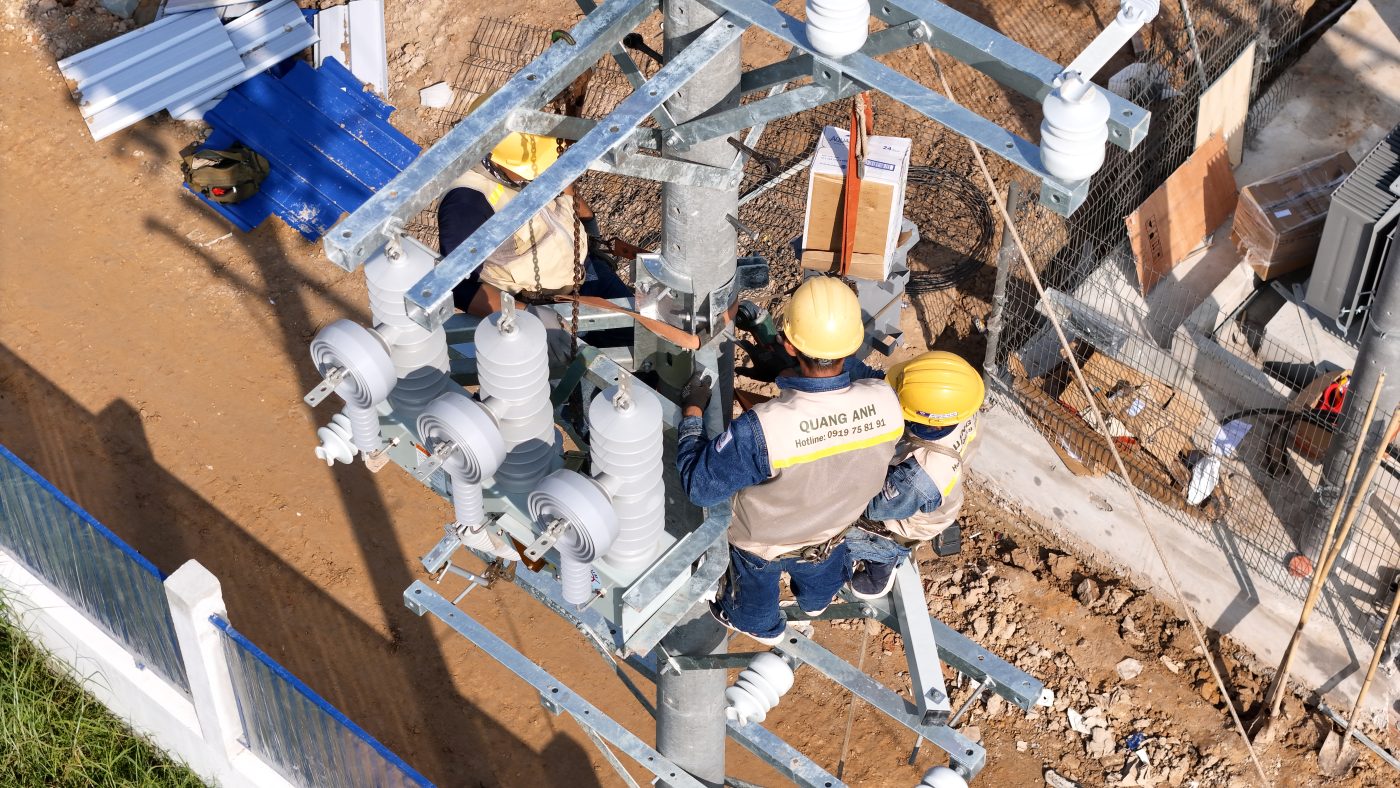
Substations at 110kV and 220kV are essential in transforming and distributing power within the national electrical network. They undertake the conversion from high to low voltages.
Duties and Roles of 110kV, 220kV Substations
These substations are integral in securing system operation efficiency and safety. Functioning as joint nodes, they convert high voltage input into suitable lower voltage output for distribution.
The importance of 110kV and 220kV substations lies in their role as intermediate nodes in voltage conversion and distribution, adjusting voltage levels to meet operational requirements.
Voltage Conversion Functionality
- 110kV – 220kV Substation: This station stages the reduction from high voltage (110kV to 220kV) to manageable voltages (like 22kV or 35kV) for efficient distribution.
Substation Responsibilities
-
Voltage Conversion Role: These stations provide standardized voltage levels ensuring efficient power distribution across networks.
-
Power Distribution Duty: Handling the flow of energy post-conversion to residential, industrial, and secondary stations, ensuring connectivity to consumer end-points.
Characteristics and Significance
-
Construction Traits: Positioned typically in remote, open areas, these substations handle expansive capacity with large-scale electrical components.
-
Grid Role: Beyond converting voltage, they regulate current, safeguarding the grid’s security and balance.
Substation Types
-
Intermediate Stations: Operating the conversion from high voltage (110kV – 220kV) to lower levels like 22kV – 35kV.
-
Distribution Stations: Adapting 22kV – 35kV down to 0.22kV – 0.4kV as necessary for distribution networks.
Overall, these substations are key components not only in conversion but also in delivering power securely and effectively to its end users.
Construction and Advanced Technology of Substations
Located mainly outdoors, these stations boast significant transformer and protection device sizes, integrating highly efficient technologies like GIS for enhancing operational safety.
Substations in power distribution networks focus on transforming voltages for specific grid needs, with technological advancements boosting system reliability and functionality.
Legacy substation structures encompass transformers, switchgear, and protection mechanisms, coordinating for uninterrupted power flow.
Contemporary Technologies and Utilization
Innovative technologies are increasingly influential in substation development, aiming to minimize risk while enhancing operational performance.
-
GIS Technology (Gas Insulation Switchgear): GIS technology employs SF6 gas, reducing footprint while bolstering safety.
-
Automation and Monitoring: These modern systems facilitate easy management and tracking of station operational statuses.
-
Digital Stations: Investigated to improve system dependability.
-
Remote Operated Stations (KNT): SCADA aids in effortless oversight and cost-effectiveness.
-
Superconducting and Automation Solutions: Enhance efficiency and control, reducing losses and boosting monitoring precision.
These advancements extend beyond structural innovations, encompassing simulation software for design precision and technical analysis.
Category and Applications of 110kV and 220kV Substations
These substations, functioning as intermediary nodes, transform power, format, and output in a system. By 2030, enhanced automation aims to streamline operations, potentially leading to unmanned substation sites.
With a critical role in supply, they adapt high voltage for specific regional demands.
Types of Substations
-
High Voltage Stations: Spanning 66kV to 500kV capacities.
-
110kV Stations: Ideal for powering extensive zones due to their budget-friendly, safe attributes.
-
220kV Stations: Serving extensive national power distribution networks.
-
Medium Voltage Stations: Filling roles in moderate scale areas.
-
Low Voltage Stations: Investing under 0.4kV for residential use.
Categorical Usage Scope
-
110kV Stations: Downscaling voltage for local service coverage.
-
220kV Stations: Conditioning heavy-duty regional power, possibly stepping it down further.
Operational Dynamics
-
Intermediate Stations: Located favorably for space and safety, converting high to mid-level voltages.
-
Distribution Stations: Dropping voltages for domestic and industrial consumption following conversion.
As vital nodes, these stations blend national and local grid functionality, regulating electricity flow with technological maturity that propels operational innovation.
Contact QuangAnhcons for expert consultancy on substation solutions at Hotline: +84 9 1975 8191.
Specializing in substation planning and construction, QuangAnhcons steps forward with operational optimization and systematic efficiency.
[contact-form-7 id="7239967" title="Contact form 1"]
Related Posts
Substation Interconnection Documentation: A Practical Preparation Guide for Investors
A hands‑on guide for investors and M&E engineers on the information groups needed in substation [...]
May
Transformer Substation Construction Quote: Cost Components & Key Cost Drivers
Guidance for breaking down a transformer substation construction quote: main cost groups and the common [...]
May
Substation Solutions for Factories: Investing and Implementation Strategies
Overview of factory substations: when to invest, key components, execution processes, documentation, and selecting the [...]
Apr
Transformer Repair in Ho Chi Minh City: When Immediate Action Is Required
Discover signs of transformer damage, diagnostic methods, on-site handling processes, and criteria for selecting repair [...]
Apr
Transformer Repair: Process, Diagnosis, and Decision-Making
Hướng dẫn sửa chữa máy biến áp cho nhà máy: nhận biết dấu hiệu hỏng, [...]
Apr
24-Hour Transformer Repair: Efficient Solutions and Reliable Power Restoration
Khung xử lý sửa chữa máy biến áp 24h cho nhà máy: nhận biết sự [...]
Apr
Common Mistakes in Transformer Station Construction Leading to Extra Costs
Các sai lầm khi làm trạm biến áp thường không nằm ở một hạng mục [...]
Apr
Comprehensive Guide to Acquiring Used Transformers
Góc nhìn kỹ thuật về thu mua TBA cũ: cách đánh giá hiện trạng, hồ [...]
Apr
Comprehensive Transformers Maintenance for Industrial Plants
Tổng quan dịch vụ bảo trì trạm biến áp nhà máy: lịch bảo dưỡng, thí [...]
Apr
Transformers: Assessing and Safely Handling Used Transformers
Khung đánh giá máy biến áp cũ theo tình trạng kỹ thuật, dầu cách điện, [...]
Apr
How Proactive Transformer Maintenance Minimizes Business Risks
Nhìn từ góc độ vận hành nhà máy, bảo trì chủ động trạm biến áp [...]
Apr
Comparing Oil and Dry Transformers in Industrial Projects
Distinguish between oil and dry transformers based on installation site, safety, maintenance, energy losses, initial [...]
Mar
Electrical Overload Warning Signs in Factories
Recognize early indicators of factory electrical overload such as voltage drops, overheating equipment, circuit breaker [...]
Mar
Risks of Overloading Industrial Transformers Without Upgrades
Keeping the same low-voltage transformer while increasing factory loads can result in overheating, insulation degradation, [...]
Mar
Evaluating and Implementing Transformer Contractors in Tay Ninh
Criteria for selecting transformer substation contractors in Tay Ninh, EPC scope, and factors affecting project [...]
Mar
Comparing Oil and Dry Transformers for Industrial Applications
Examine oil and dry transformers based on installation location, fire safety, maintenance, energy loss, investment [...]
Mar
Comprehensive 1500kVA Transformer Station Budget for Manufacturing Facilities
Guidance for creating a detailed budget list for a 1500kVA transformer station, including medium voltage [...]
Mar
Comprehensive Transformer Station Pricing: Elements and Considerations
Examine key components in comprehensive transformer station pricing including design, equipment, construction, testing, and connection [...]
Mar
Pricing Guide for 4000kVA Transformer Stations: Configuration, Cost, and Investment Process
An overview of configuration, cost estimates, connection approaches, and investment checklists for 4000kVA transformer stations [...]
Mar
Pricing and Setup of 3200kVA Transformer Stations: Configuration, Costs, and Investment Procedure
Explore the pricing structure for a 3200kVA transformer station, primary equipment configuration, cost variables, EVN [...]
Mar