

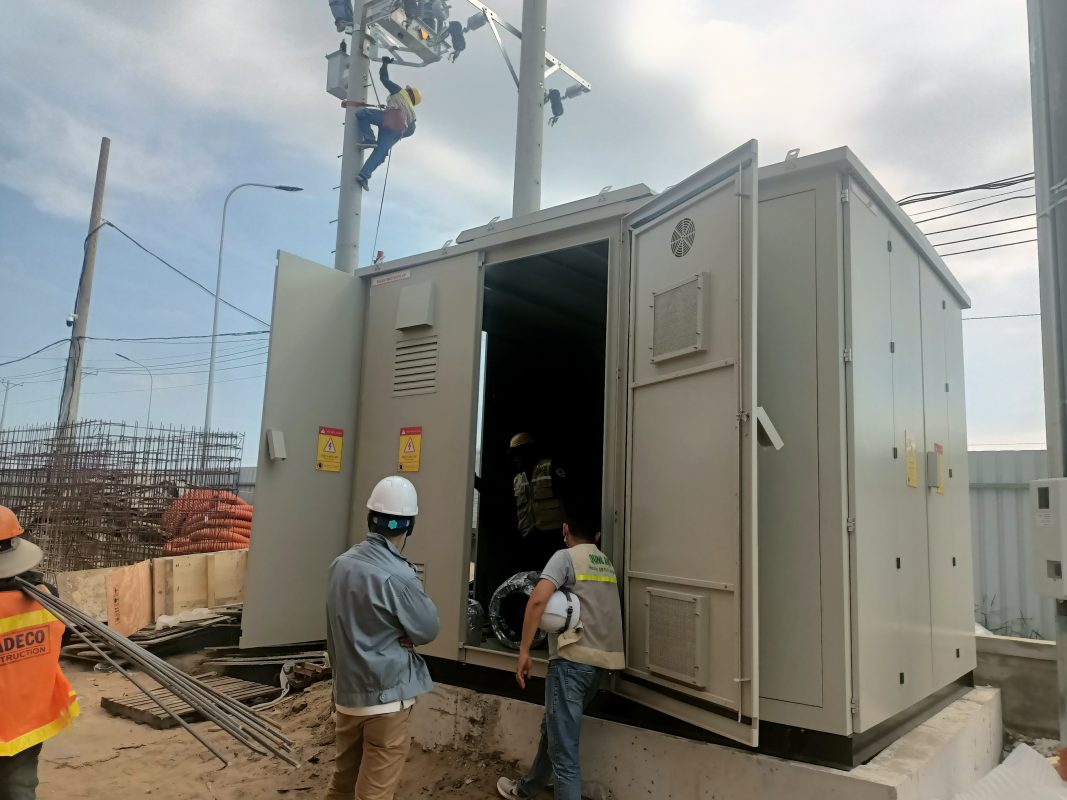
Discover the essence of Factory Substations, which are pivotal in efficiently altering and transmitting electricity within industrial settings, ensuring seamless operation of machinery.
Understanding Factory Substations and Their Role
These substations serve as critical electrical apparatuses, facilitating the conversion and transmission of power. Essential for maintaining safe and steady factory operations, they include transformers, control units, protective systems, and more, stabilizing power flow for production activities.
Recognizing the significance and functionality of factory substations empowers businesses to optimize energy management, crucial for protecting both performance and safety.
Concept of Factory Substations
Factory substations are integral in the distribution of electricity, transforming high-voltage inputs for safe use in machinery.
Role of Factory Substations
Substations contribute to several key functions, ensuring continuous plant operations:
- Voltage Conversion: Adjusts from high levels like 110kV, serving specific voltage needs.
- Power Distribution: Employs modern devices for efficient power spread.
- Safety and Control: Equipped with protective technologies to avert faults.
- Power Stability: Maintains uninterrupted production.
Common Elements of Factory Substations
Key components include:
- Transformer: Adjusts system voltage levels.
- Busbars and Isolators: Allow distribution and isolation during maintenance.
- Measurement and Protection: Ensures security and monitoring.
- Earthing Safety: Provides protection against electrical hazards.
- Own-Power System: Powers the substation.
- Operational Zone: Manages maintenance and electricity flow.
These facilities not only adjust voltage but manage distribution, protection, and stability.
Different Types and Uses of Industrial Substations
Industrial substations are categorized by voltage—extra-high, high, medium, and low—each serving distinct industrial requirements, from expansive parks to localized factories.
Industrial Substations are tailored for different voltage needs, enhancing electrical safety and stability.
- Extra-High Voltage: Powers large-scale systems.
- High Voltage: Supports major industrial sectors.
- Medium Voltage: Caters to average-scale factories.
- Low Voltage: Suitable for small zones and residencies.
Highlighting designs for industrial environments:
- Pole-Mounted: Compact solutions on poles for tight areas.
- Frame-Mounted: Facilitates high-voltage needs in heavy industry.
- Kios Substations: Used in enclosed urban and residential settings.
Industrial electrical substations manage power supply, transform voltages, and protect environments effectively.
Construction and Upkeep of Substations
Accurate adherence to technical safety standards is vital when erecting substations. The choice of location impacts safety and maintenance ease, following stringent regulation during development.
Substation Setup Procedures
- Planning: Select safe and strategic sites, prepare equipment.
- Infrastructure Building: Establish solid groundwork with effective drainage.
- Device Installation: Place essential components and secure connections.
- Testing: Confirm operational readiness through comprehensive tests.
Maintenance Protocols
- Surveys: Regular evaluations to spot issues early.
- Cleanup: Routine cleaning of parts and systems.
- Inspections: Thorough reviews of cables and insulation values.
- Enhancements: Modernize components and fill necessary oils.
- Recordkeeping: Log and scrutinize for optimal function dispatch.
Maintenance Improvement
- Proposals: Draft necessary maintenance plans.
- Repairs: Address and restore any critical wear and tear.
Substations operate effectively when a robust construction and maintenance program is executed.
Efficiently established factory substations contribute greatly to energy optimization and safety, integral to modern industrial strategies.
For expert substation solutions, reach QuangAnhcons at Hotline: +84 9 1975 8191.
QuangAnhcons guarantees professional services in substation setup and maintenance, complying with all technical safety standards, facilitating energy-efficient factory operations.
[contact-form-7 id="7239967" title="Contact form 1"]
Related Posts
Substation Interconnection Documentation: A Practical Preparation Guide for Investors
A hands‑on guide for investors and M&E engineers on the information groups needed in substation [...]
May
Transformer Substation Construction Quote: Cost Components & Key Cost Drivers
Guidance for breaking down a transformer substation construction quote: main cost groups and the common [...]
May
Substation Solutions for Factories: Investing and Implementation Strategies
Overview of factory substations: when to invest, key components, execution processes, documentation, and selecting the [...]
Apr
Transformer Repair in Ho Chi Minh City: When Immediate Action Is Required
Discover signs of transformer damage, diagnostic methods, on-site handling processes, and criteria for selecting repair [...]
Apr
Transformer Repair: Process, Diagnosis, and Decision-Making
Hướng dẫn sửa chữa máy biến áp cho nhà máy: nhận biết dấu hiệu hỏng, [...]
Apr
24-Hour Transformer Repair: Efficient Solutions and Reliable Power Restoration
Khung xử lý sửa chữa máy biến áp 24h cho nhà máy: nhận biết sự [...]
Apr
Common Mistakes in Transformer Station Construction Leading to Extra Costs
Các sai lầm khi làm trạm biến áp thường không nằm ở một hạng mục [...]
Apr
Comprehensive Guide to Acquiring Used Transformers
Góc nhìn kỹ thuật về thu mua TBA cũ: cách đánh giá hiện trạng, hồ [...]
Apr
Comprehensive Transformers Maintenance for Industrial Plants
Tổng quan dịch vụ bảo trì trạm biến áp nhà máy: lịch bảo dưỡng, thí [...]
Apr
Transformers: Assessing and Safely Handling Used Transformers
Khung đánh giá máy biến áp cũ theo tình trạng kỹ thuật, dầu cách điện, [...]
Apr
How Proactive Transformer Maintenance Minimizes Business Risks
Nhìn từ góc độ vận hành nhà máy, bảo trì chủ động trạm biến áp [...]
Apr
Comparing Oil and Dry Transformers in Industrial Projects
Distinguish between oil and dry transformers based on installation site, safety, maintenance, energy losses, initial [...]
Mar
Electrical Overload Warning Signs in Factories
Recognize early indicators of factory electrical overload such as voltage drops, overheating equipment, circuit breaker [...]
Mar
Risks of Overloading Industrial Transformers Without Upgrades
Keeping the same low-voltage transformer while increasing factory loads can result in overheating, insulation degradation, [...]
Mar
Evaluating and Implementing Transformer Contractors in Tay Ninh
Criteria for selecting transformer substation contractors in Tay Ninh, EPC scope, and factors affecting project [...]
Mar
Comparing Oil and Dry Transformers for Industrial Applications
Examine oil and dry transformers based on installation location, fire safety, maintenance, energy loss, investment [...]
Mar
Comprehensive 1500kVA Transformer Station Budget for Manufacturing Facilities
Guidance for creating a detailed budget list for a 1500kVA transformer station, including medium voltage [...]
Mar
Comprehensive Transformer Station Pricing: Elements and Considerations
Examine key components in comprehensive transformer station pricing including design, equipment, construction, testing, and connection [...]
Mar
Pricing Guide for 4000kVA Transformer Stations: Configuration, Cost, and Investment Process
An overview of configuration, cost estimates, connection approaches, and investment checklists for 4000kVA transformer stations [...]
Mar
Pricing and Setup of 3200kVA Transformer Stations: Configuration, Costs, and Investment Procedure
Explore the pricing structure for a 3200kVA transformer station, primary equipment configuration, cost variables, EVN [...]
Mar