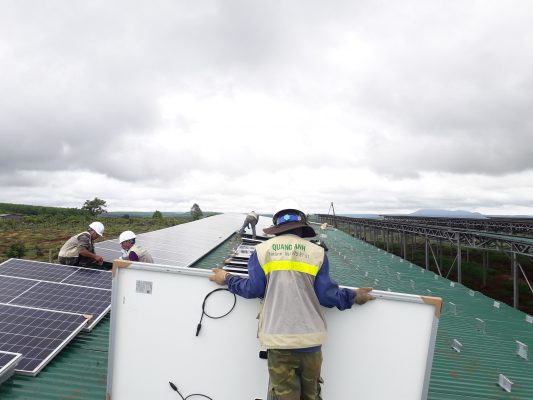
Estimate industrial rooftop solar PV budgets in Vietnam using kWp, roof area, inverter, electrical BOQ, factory self-consumption and optional BESS.
QUANGANHCONS · PV & BESS COST TOOLS
Industrial Rooftop Solar Cost Calculator for Vietnam Factories
Screen project kWp, usable roof area, inverter capacity, factory self-consumption and MV/LV integration before a formal EPC tender. Compare the cost drivers and prepare a more precise RFQ.
Before you price a project: Use real load and site assumptions. The result is budgetary and does not expose internal procurement discounts or guarantee project performance.
Open the QuangAnhcons rooftop solar calculator
Enter the PV system and roof information. Review all assumptions, grid interfaces and excluded works.
Separate kWp, AC kW and annual kWh
DC array capacity (kWp), inverter AC capacity (kW) and annual electricity generated (kWh) are different quantities. The useful energy depends on production schedules, shading, conversion losses, roof condition and whether PV output can be consumed on site.
Procurement should use the actual factory interval load, expected operating shifts, weekend production and export restrictions. A rooftop with sufficient space does not guarantee the same self-consumption or payback as a similarly sized plant.
Build a comparable solar EPC scope
A meaningful BOQ separates modules, inverters, racking, DC/AC cables, distribution boxes, earthing, SPD, monitoring, installation, testing and handover. Roof strengthening, MSB/transformer upgrades, cable-trench work, electrical outages and project-specific fire requirements should be stated as included or excluded.
Ask bidders to use the same SLD, load profile, acceptable manufacturers, design assumptions, delivery conditions and performance model. Do not compare USD/kWp figures without reconciling scope.
Protect the factory electrical interface
Confirm the PCC, MSB busbar loading, transformer capacity, available fault level, anti-islanding/export control, coordination of protection and the applicable regulatory and utility interface. Grid approvals and engineering sign-off are project-specific.
The calculator provides budget guidance, not a certified rooftop structural assessment, detailed installation design or binding EPC price.
Technical & commercial input matrix
Input
Example
Why it matters
Available roof
Area, loading, obstacles
Capacity and mounting design
Factory demand
Bills and interval profile
Self-consumption
PV size
100kWp–1MWp+ as appropriate
Materials and AC design
Grid connection
SLD, MSB, transformer
Protection and integration
Storage (optional)
kW, kWh, duty
Additional PCS/BESS cost
Programme
Site access, shutdowns
Installation cost and schedule
All numerical examples are assumptions for screening only. Quote equipment by datasheet and design.
Frequently asked questions
How much does a 500kWp or 1MWp rooftop solar EPC cost in Vietnam?
It depends on project design, equipment, roof condition, electrical interface and market quotations. This tool provides a preliminary estimate for the selected inputs, subject to verification.
How should a factory optimize self-consumption?
Use interval load data, production schedule, inverter sizing and any applicable export constraints; do not size only from total roof area.
Does the tool include battery storage?
The Solar Quick interface provides optional BESS/storage inputs as available for the selected configuration. Final battery design and safety require separate verification.
Can these results be used directly as a contract offer?
No. A binding quotation needs approved scope, BOQ, equipment specifications, exclusions, taxes and validated financial assumptions.
Select the capacity, route lengths and package to view your indicative budget and electrical parameters.
01 Quick estimate
Request a project quotation
Send your project details, BOQ or drawings to request a formal quotation. Fields marked * are required.
Quotation scope
Applies to one EVN-supplied substation with oil-immersed transformers at 22/0.4 kV (single-phase: 12.7/0.23 kV), with MV metering VTs/CTs supplied by EVN. The estimate includes the selected equipment, installation, earthing, transformer-to-main-breaker connections, design and connection documentation, and coordination of testing and utility acceptance.
Kiosk, integrated steel-pole and indoor substations include MV switchgear and the entered underground cable route. Other outdoor arrangements use the relevant protection configuration. The final diagram must meet the project connection requirements.
Excludes VAT, cables from the substation switchboard to the MSB/loads, live-line work, harmonic reactors, weak-ground treatment or special piling, land and special fire-protection provisions. Underground routes assume normal construction conditions and exclude road drilling and special reinstatement.
Prices are indicative investment budgets. A formal quotation follows site assessment and agreement on the configuration. Electrical selections are preliminary and require design verification before installation.
Capacity range and application conditions
The catalogue defines the enquiry range of this tool, not universal TCVN capacity limits. Single pole-mounted transformers: 15–100 kVA; three-unit banks: 3×15–3×100 kVA. Platform substations: 100–630 kVA. Steel-pole substations: 100–630 kVA; 750/800 kVA require design verification and local approval. Ground-mounted, kiosk and indoor configurations: 50–10,000 kVA. Not every configuration has a package price or the same structural design.
Reference: EVN Decision 1299/QD-EVN dated 3 November 2017, Volume 1, sections 3.3–3.4. Check the current requirements of the responsible utility before implementation. Kiosks must meet manufacturer ratings and testing requirements (IEC 62271-202); indoor and ground-mounted arrangements must meet project layout, ventilation, structural and fire-protection requirements. For multiple transformers, specify the quantity and capacity of each unit.