

Table of Contents:
Investing in a 1MWp solar power system in Vietnam ranges from 8.5 to 15 million VND per kWp, influenced by equipment quality, product brand, and system scale.
Economic Benefits of Solar Power
The investment for a 1MWp solar power system varies from 8.5 to 15 million VND per kWp, with differences attributed to equipment quality, brand, and system size. Medium-quality equipment might cost up to 15 million VND per kWp, while larger systems over 1 MWp can lower costs to about 8.5 million VND per kWp due to economies of scale. The return on investment is typically 4-5 years, aided by reduced costs and attractive selling prices in Vietnam, especially with electricity prices reaching 3,000-4,300 VND per kWh during peak hours.
Solar power plays a vital role in providing clean, sustainable energy in Vietnam, offering substantial economic benefits. First, the system reduces energy costs for households and businesses. In recent years, the production and installation costs of solar energy systems have decreased significantly, facilitating cost savings and promoting sustainable development.
Another noteworthy advantage is job creation and boosting local economies. Installing, operating, and maintaining solar energy equipment, such as from reputable brands like ABB and Schneider, can generate numerous job opportunities, supporting community economic growth and national energy security.
Businesses also benefit from increased productivity and reduced production costs with solar power. By notably reducing operating costs, particularly during peak hours, companies can optimize profits and achieve a fast return on investment, typically a few to over ten years, depending on the industry.
Solar energy systems also alleviate stress on the national grid. Distributed electricity generation from solar sources greatly reduces the risk of grid overload, ensuring higher stability and safety for the national electricity system.
Importantly, using solar energy fosters sustainable economic development and reduces CO2 emissions. As a renewable energy source, solar power not only decreases reliance on fossil fuels but also limits greenhouse gas emissions, improving environmental quality. Additionally, solar systems enhance asset value and build a green brand for businesses, reflecting a commitment to the environment and winning trust from customers and partners.
Factors Affecting Investment Cost
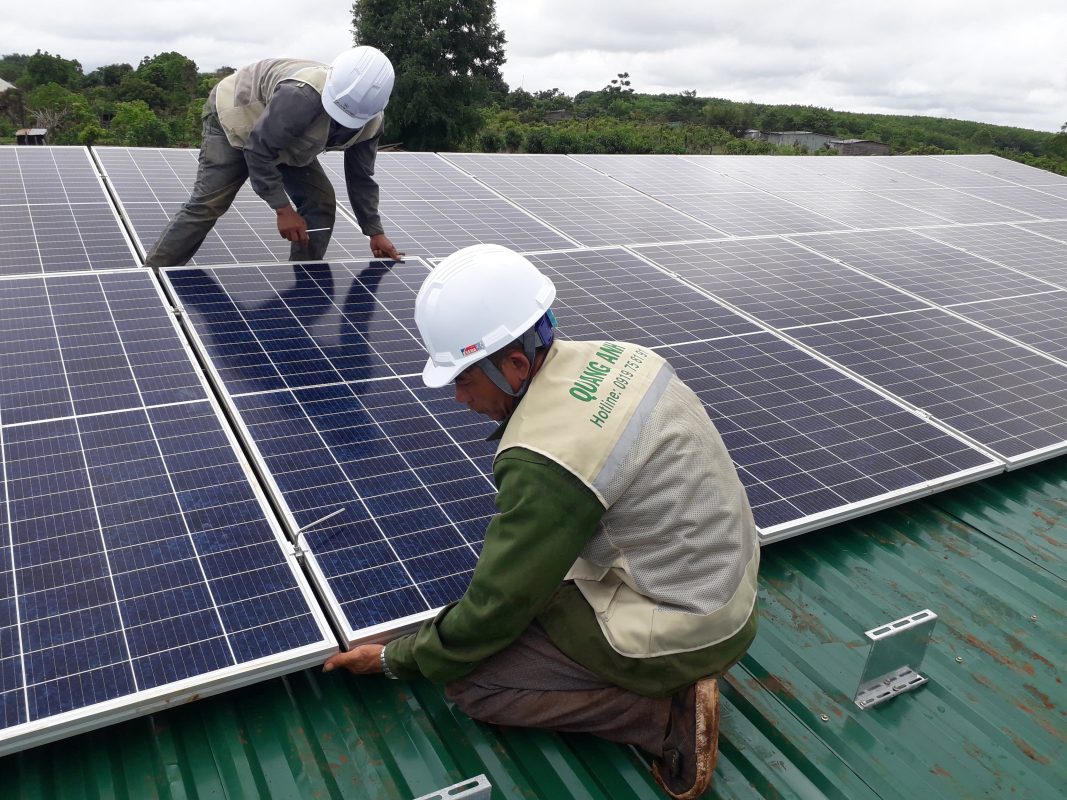
The main factors affecting the investment cost for a solar power system include the quality and brand of solar panels (accounting for about 60% of the total investment cost), roof structure, land area used, and geographical location. Different regions influence the electricity output, with 1 kWp generating 4-5 kWh/day, equivalent to 120-150 kWh/month. A 1 MWp system can produce around 180,000 kWh/month depending on the installation area.
Determining the investment cost for a solar power system is influenced by diverse factors, including economic, social, financial, and legal aspects. A prominent factor is the interest rate on loans, which directly impacts investment decisions. When interest rates rise, borrowing becomes more challenging, increasing loan costs, and significantly affecting investor decisions.
Additionally, the business environment and legal policies play crucial roles. A favorable business environment with quick administrative procedures minimizes time and unofficial costs, enhancing investment appeal. Local legal regulations can be a hurdle or a catalyst for investment activities, depending on their alignment with proposed investment costs.
The Provincial Competitiveness Index (PCI) is also vital, with factors like market entry costs, land access, administrative procedures, information accessibility, support services, and labor training. These elements contribute to the safety and efficiency of investments in specific areas.
For enterprises, intrinsic factors like expected profit margins, fixed assets, debt levels, and ownership types significantly impact capital mobilization and investment decisions. Social factors cannot be overlooked, as community influence, peers, and investment advisory organizations can sway final investment decisions.
Finally, inflation rates and financial market conditions are essential considerations in any investment decision, as they directly affect interest rates and investment costs.
These factors collectively shape investment decisions for each solar power project.
Government Support Policies
The Vietnamese government encourages the development of rooftop solar power systems with Decision No. 11/2017/QD-TTg and regulations from the Ministry of Industry and Trade, like Circular 16/2017/TT-BCT. Decree 135/2024/ND-CP has also been issued to promote solar power development, making it easier for enterprises and individuals to access this renewable energy source.
In the coming years, Vietnam’s energy policy focuses on developing supportive industries, technological transfer, and digital transformation to promote sustainable development and optimize Vietnam’s electricity market. New decrees will bring significant changes and notable support for the economy:
- Development of supporting industries: Decree 205/2025/ND-CP, effective from 01/9/2025, encourages organizations and individuals to engage in research applications, technological innovation, and improvement. This will benefit from funds like the National Innovation Technology Fund and the National Science and Technology Development Fund, contributing to the development of supporting industries and Vietnam’s electricity market.
- Reviving agricultural production: Decree 9/2025/ND-CP will be effective from early 2025 to support agricultural production affected by natural disasters. The government will provide financial assistance for crops, livestock, and aquaculture, with specific support levels for aquaculture reaching up to 60 million VND/ha.
- Digital transformation and cybersecurity: Decree 179/2025/ND-CP, effective from 15/8/2025, provides a subsidy of 5 million VND/month for participants in digital transformation and information security. This promotes cybersecurity management development and fosters sustainable technological development.
- Public investment disbursement acceleration: In 2025, the government plans to expedite public investment disbursement with a target rate of at least 95% of the planned amount, aiming to stimulate economic growth and complete critical infrastructure projects like highways and airports.
Investing in a 1MWp solar power system offers numerous economic and technical benefits. With an investment range of 8.5 to 15 million VND per kWp and a quick return period of 4-5 years, it is a viable option for large enterprises looking to optimize costs and achieve sustainable growth.
Contact QuangAnhcons at hotline +84 9 1975 8191 for detailed consultancy on the investment and installation of a 1MWp solar power system.
QuangAnhcons offers high-quality consultancy and installation services for solar power systems, optimizing costs for businesses and adhering to government sustainable development policies.
[contact-form-7 id="7239967" title="Contact form 1"]
Related Posts
Comparing Oil and Dry Transformers in Industrial Projects
Distinguish between oil and dry transformers based on installation site, safety, maintenance, energy losses, initial [...]
Mar
Electrical Overload Warning Signs in Factories
Recognize early indicators of factory electrical overload such as voltage drops, overheating equipment, circuit breaker [...]
Mar
Risks of Overloading Industrial Transformers Without Upgrades
Keeping the same low-voltage transformer while increasing factory loads can result in overheating, insulation degradation, [...]
Mar
Evaluating and Implementing Transformer Contractors in Tay Ninh
Criteria for selecting transformer substation contractors in Tay Ninh, EPC scope, and factors affecting project [...]
Mar
Comparing Oil and Dry Transformers for Industrial Applications
Examine oil and dry transformers based on installation location, fire safety, maintenance, energy loss, investment [...]
Mar
Comprehensive 1500kVA Transformer Station Budget for Manufacturing Facilities
Guidance for creating a detailed budget list for a 1500kVA transformer station, including medium voltage [...]
Mar
Comprehensive Transformer Station Pricing: Elements and Considerations
Examine key components in comprehensive transformer station pricing including design, equipment, construction, testing, and connection [...]
Mar
Pricing Guide for 4000kVA Transformer Stations: Configuration, Cost, and Investment Process
An overview of configuration, cost estimates, connection approaches, and investment checklists for 4000kVA transformer stations [...]
Mar
Pricing and Setup of 3200kVA Transformer Stations: Configuration, Costs, and Investment Procedure
Explore the pricing structure for a 3200kVA transformer station, primary equipment configuration, cost variables, EVN [...]
Mar
Cost Estimation for 2500kVA Transformer Station: Configuration, Expenses, and Investment Process
Reference framework for quoting a 2500kVA transformer station based on configuration, station type, cable solutions, [...]
Mar
2000kVA Transformer Station Guide: Configuration, Costs, and Investment Process
Discover key aspects of a 2000kVA transformer station: from technical configuration and cost analysis to [...]
Mar
Pricing and Configuration Guide for 1600kVA Substations
A detailed guide on pricing for 1600kVA substations, including equipment specs, connection costs, EVN procedures, [...]
Mar
Comprehensive Guide to 1500kVA Substation Pricing: Configuration, Costs, and Investment Process
A comprehensive overview of configurations, costs, construction methods, connection procedures, and contractor selection for 1500kVA [...]
Mar
Tay Ninh Solar Power Planning: Technical Framework, Grid Interconnection, and Rollout Roadmap
Technical overview of solar planning in Tay Ninh: irradiation, grid capacity, permitting, design, operations, and [...]
Dec
Binh Duong Solar Planning: Regulatory Framework, Grid Interconnection, and an Implementation Roadmap for Factories and Industrial Parks
An overview of Binh Duong solar planning: legal framework, interconnection, design, risk management, and an [...]
Dec
Solar Farm Repair: O&M Workflow, IV Curve Diagnostics, Thermography, Inverter Service and Utility-Scale Safety
A utility-scale solar farm repair plan centered on O&M, IV curves, thermal imaging, inverter service, [...]
Dec
Dong Nai Solar Power Plan 2023–2025: Tri An 1,029 MW, Grid Upgrades and the DPPA Pathway
A complete look at Dong Nai’s solar power plan: Tri An 1,029 MW, irradiation potential, [...]
Nov
Quang Ngai Solar Power Plan 2024–2030: Legal Framework, Irradiance Potential, and Development Roadmap
A complete look at Quang Ngai’s solar power plan: capacity targets, irradiance (PVout), development zones, [...]
Nov
Solar Damage Assessment Services: On-Site Procedures, EL/IV/Thermography Testing & Compliance with Standards
Discover IEC/UL/NEC standard solar damage assessment processes: on-site evaluation, EL and IV curve testing, thermal [...]
Nov
Comprehensive Package Estimate for a 1800MVA 500kV Substation: Scope, Configuration 3x600MVA, Standards and Timeline Management
An overview of the 1800MVA 500kV substation estimate: construction scope, configuration 3x600MVA, GIS/AIS, SCADA, standards, [...]
Nov