

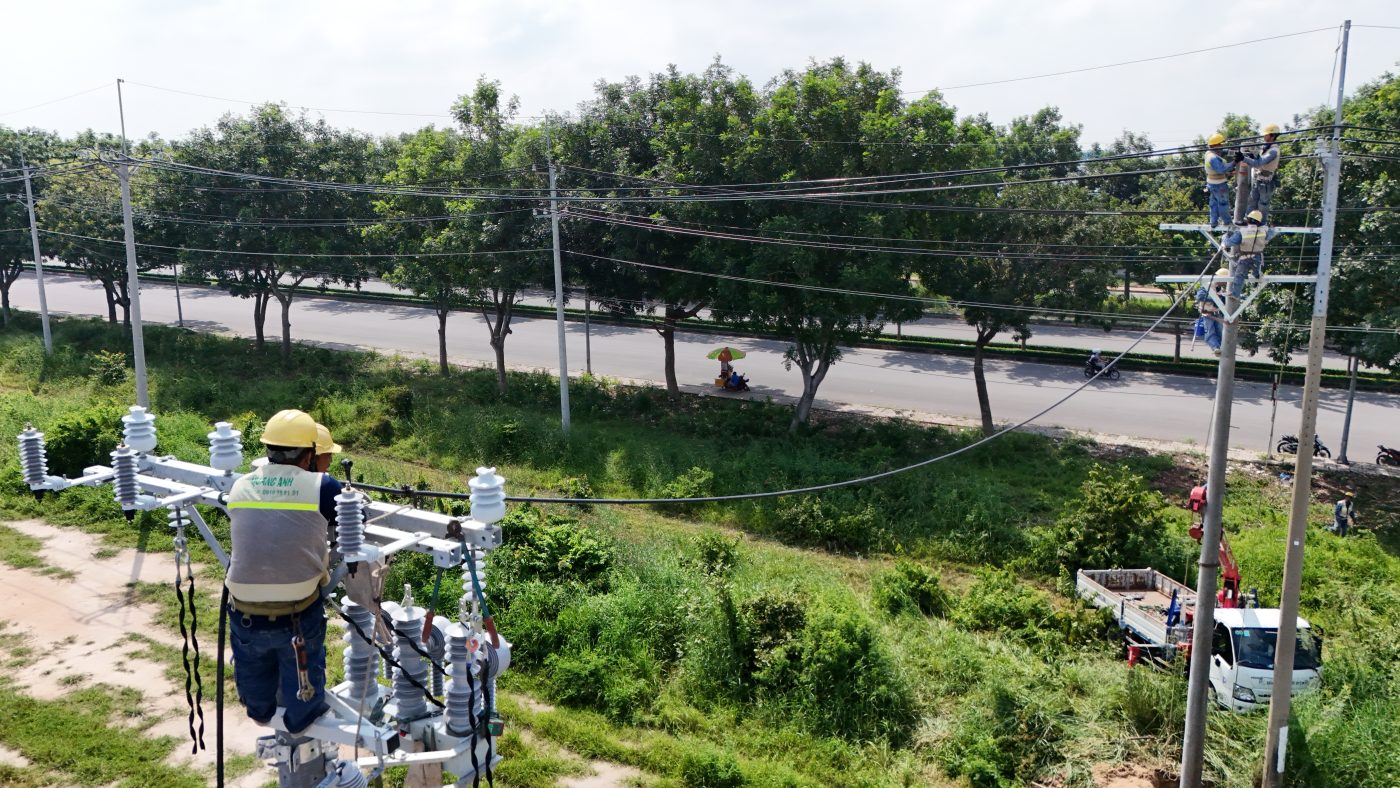
QuangAnhCons specializes in the construction of large capacity substations, exemplified by the 2x2500kVA project at Nhon Trach II. This facility supplies power to the RVN Fibers plant, showcasing exceptional engineering and project management capabilities.
Significance of the 2x2500kVA Substation
The 2x2500kVA substation at Nhon Trach II is crucial for powering the RVN Fibers facility. With a substantial capacity of up to 5000 kVA, it effectively accommodates the plant’s electrical demands. The substation contractor, QuangAnhCons, ensures all stages from design to installation comply with Vietnam’s stringent electrical industry standards.
As a key component in Vietnam’s power transmission and distribution network, particularly in high-demand areas such as factories, industrial zones, and skyscrapers, the substation with a total capacity of 5000 kVA guarantees steady and uninterrupted electricity supply to large power loads.
The use of dual transformers not only enhances power stability but also increases operational safety. In the event of a transformer failure, the other can continue to operate, maintaining power supply, critically important for highly reliable electricity needs like hospitals or national defense agencies.
This high-capacity substation enables efficient power distribution, capable of transmitting high-power load electricity. Its flexible design allows for outdoor or technical room placement, optimizing suitability for each specific project. Another crucial benefit is cost and energy savings in operation, reducing electrical loss and conductor power loss.
Additionally, operational flexibility of the substation is enhanced with the ability to alternate or backup between two transformers, minimizing power outage risks during maintenance or malfunctions, thereby boosting the system’s safety. In the construction and energy sector, the 2x2500kVA substation not only optimizes power distribution but also supports suitable designs that save on conductors and ensure electrical safety.
Equipped to meet diverse energy needs for sectors requiring substantial power consumption, from industrial parks to luxury high-rises, this substation plays a pivotal role in providing stable and efficient electricity supply.
Innovative Technology and Techniques in Substation Installation
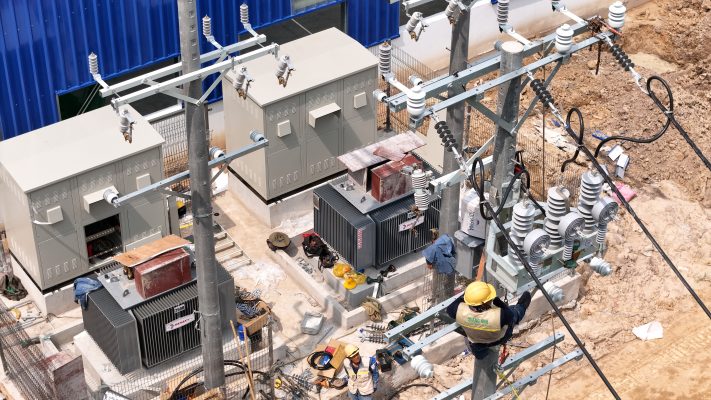
The 2x2500kVA substation contractor, QuangAnhCons, integrates modern technology with high-quality 2500kVA transformers, ACB 4000A circuit breakers, and 1000 kVar reactive power compensation systems. Combining cutting-edge technology with expert technicians ensures stable operations under a 22kV voltage structure.
Applying advanced technology and techniques during substation installation is vital for efficiency and safety. The standard construction process involves multiple critical stages. Initially, thorough on-site surveys determine the optimal locations for pole foundations and medium voltage underground cable routes.
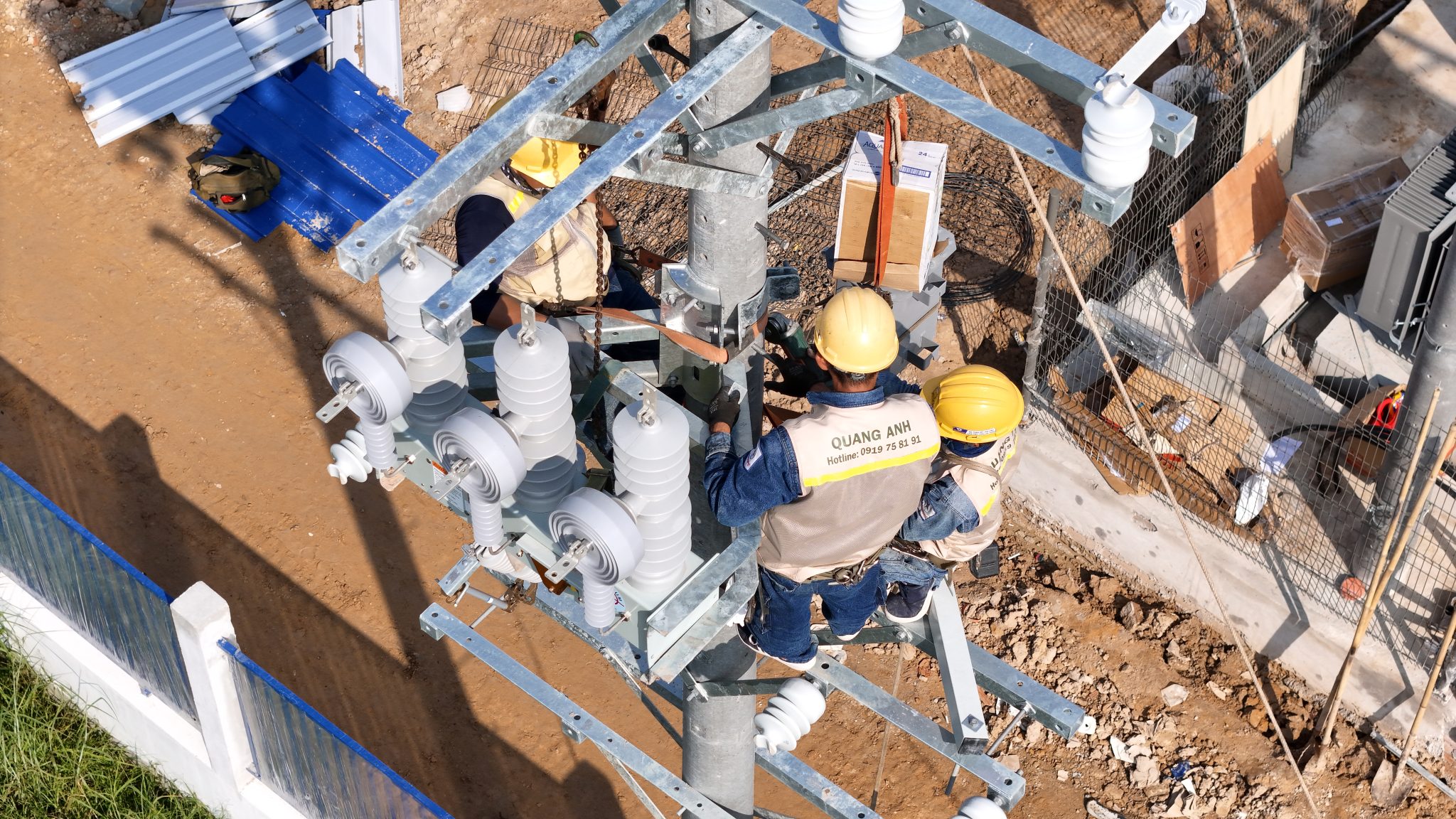
Subsequent steps include foundation excavation, protective cable conduit installation, and grounding system construction to protect and ensure the substation’s operational safety from leakage currents, lightning, and storms. Pouring concrete for the foundation and assembling components like disconnect switches, operation chairs, cross-arms, insulators, transformer installation, cable connections, and warning sign installation are indispensable steps. Particularly in ultra-high voltage substation installation, advanced installation technology and equipment testing under skilled engineers’ execution are essential for precise operation of the computer-controlled system.
Depending on requirements and terrain conditions, various substation types with corresponding technology are employed:
- Suspension substations for outdoor environments due to low cost and compact design.
- KIOS substations, portable and aesthetically pleasing, are optimal in confined spaces like industrial workshops.
- Indoor substations ensure safety, suitable for extensive industrial facilities requiring minimal disruption.
- Single-post substations with compact design fit well in crowded areas.
- GIS substations, the most advanced with encapsulated gas-insulated SF6 switchgear, significantly reduce required area compared to outdoor substations, ideal for space-constrained cities.
The SCADA-integrated control and automation system allows for automatic monitoring and operation of equipment, ensuring the stability and safety of the power grid.
To sum up, integrating advanced technology from construction processes, stringent testing, to the application of automation systems enhances the quality and operational efficiency of substations, meeting today’s increasingly diverse and demanding power requirements.
Project Management Procedures and Technical Standards
QuangAnhCons excels with its rigorous project management process, conforming to electrical industry technical standards to ensure project timelines and quality. The 2x2500kVA substation at Nhon Trach is overseen by an experienced team, guaranteeing every construction step is safe and efficient. Implemented with a comprehensive 22kV electrical project management strategy, QuangAnhCons minimizes errors and optimizes power resources.
In construction and energy fields, applying internationally recognized project management standards like ISO 21500:2012 and TCVN 11866:2017 is crucial. This process generally includes five main stages to ensure project efficacy and success.
- Initiating
Project initiation is the first step where overall objectives and strategies are identified. Identifying stakeholders and potential risks is necessary. This phase involves project charter approval and strategic execution planning. - Planning
In this phase, detailed planning is critical. The project team allocates tasks, defines timeframes and budgets, and analyzes risks to prepare appropriate response strategies. - Executing
This is the phase where tasks are carried out. Close monitoring is essential, allowing for timely issue resolution and ensuring quality progress. - Monitoring and Controlling
This stage involves tracking performance, costs, and quality to ensure alignment with the plan. Rapid corrective measures are necessary when deviations occur. - Closing
Project closure includes the handover of complete documentation and products, alongside evaluating results and releasing resources.
Beyond adhering to management processes, technical standards like TCVN 11866:2017, TCVN 11868:2017 guide the formulation and adjustment of technical regulations during project execution. This is significant for achieving top management efficiency, from defining authority and responsibility to coordinating activities transparently and effectively.
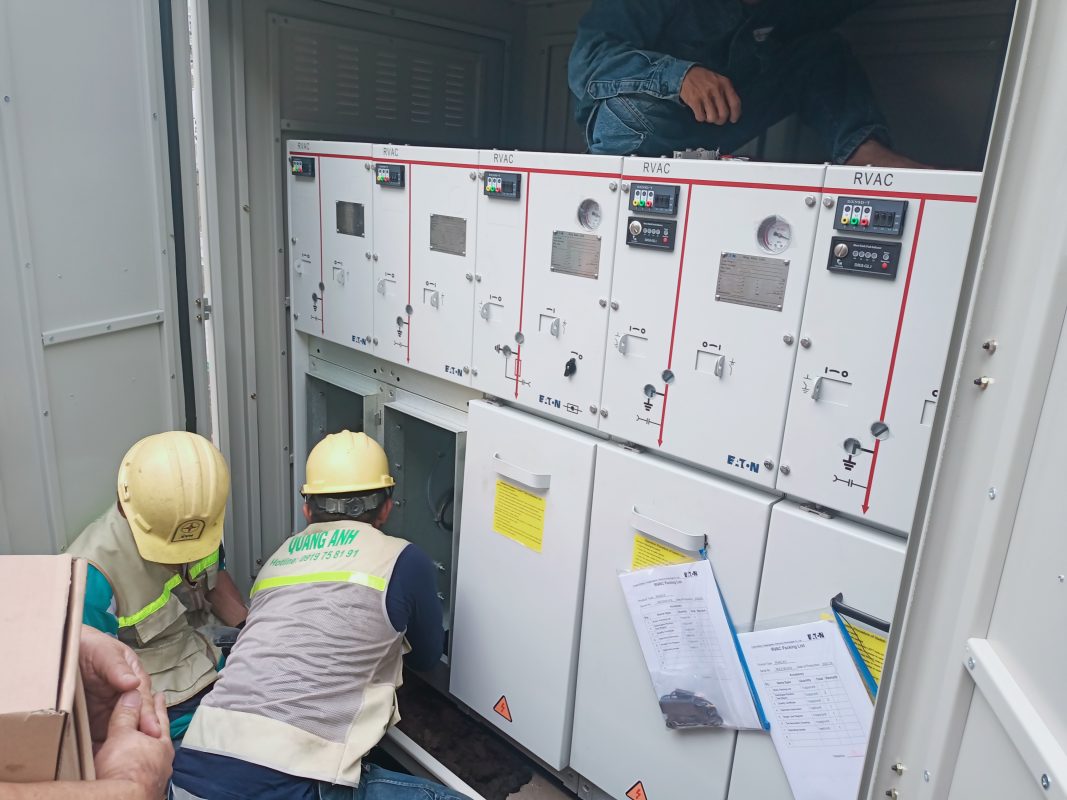
The execution of the 2x2500kVA substation project by QuangAnhCons not only demonstrates technical expertise but also forms a long-term strategy in providing energy to large industrial zones. This project ensures not just investment efficiency but also sustainability and stability in power supply.
Contact QuangAnhCons via Hotline: +84 9 1975 8191 for optimal energy solutions consultation.
QuangAnhCons offers large-capacity substation construction services, from design, execution to commissioning. The company ensures safe, reliable, and stable solutions for industrial zones, with the capability to implement up to 35kV power levels.
[contact-form-7 id="7239967" title="Contact form 1"]
Related Posts
Comparing Oil and Dry Transformers in Industrial Projects
Distinguish between oil and dry transformers based on installation site, safety, maintenance, energy losses, initial [...]
Mar
Electrical Overload Warning Signs in Factories
Recognize early indicators of factory electrical overload such as voltage drops, overheating equipment, circuit breaker [...]
Mar
Risks of Overloading Industrial Transformers Without Upgrades
Keeping the same low-voltage transformer while increasing factory loads can result in overheating, insulation degradation, [...]
Mar
Evaluating and Implementing Transformer Contractors in Tay Ninh
Criteria for selecting transformer substation contractors in Tay Ninh, EPC scope, and factors affecting project [...]
Mar
Comparing Oil and Dry Transformers for Industrial Applications
Examine oil and dry transformers based on installation location, fire safety, maintenance, energy loss, investment [...]
Mar
Comprehensive 1500kVA Transformer Station Budget for Manufacturing Facilities
Guidance for creating a detailed budget list for a 1500kVA transformer station, including medium voltage [...]
Mar
Comprehensive Transformer Station Pricing: Elements and Considerations
Examine key components in comprehensive transformer station pricing including design, equipment, construction, testing, and connection [...]
Mar
Pricing Guide for 4000kVA Transformer Stations: Configuration, Cost, and Investment Process
An overview of configuration, cost estimates, connection approaches, and investment checklists for 4000kVA transformer stations [...]
Mar
Pricing and Setup of 3200kVA Transformer Stations: Configuration, Costs, and Investment Procedure
Explore the pricing structure for a 3200kVA transformer station, primary equipment configuration, cost variables, EVN [...]
Mar
Cost Estimation for 2500kVA Transformer Station: Configuration, Expenses, and Investment Process
Reference framework for quoting a 2500kVA transformer station based on configuration, station type, cable solutions, [...]
Mar
2000kVA Transformer Station Guide: Configuration, Costs, and Investment Process
Discover key aspects of a 2000kVA transformer station: from technical configuration and cost analysis to [...]
Mar
Pricing and Configuration Guide for 1600kVA Substations
A detailed guide on pricing for 1600kVA substations, including equipment specs, connection costs, EVN procedures, [...]
Mar
Comprehensive Guide to 1500kVA Substation Pricing: Configuration, Costs, and Investment Process
A comprehensive overview of configurations, costs, construction methods, connection procedures, and contractor selection for 1500kVA [...]
Mar
Tay Ninh Solar Power Planning: Technical Framework, Grid Interconnection, and Rollout Roadmap
Technical overview of solar planning in Tay Ninh: irradiation, grid capacity, permitting, design, operations, and [...]
Dec
Binh Duong Solar Planning: Regulatory Framework, Grid Interconnection, and an Implementation Roadmap for Factories and Industrial Parks
An overview of Binh Duong solar planning: legal framework, interconnection, design, risk management, and an [...]
Dec
Solar Farm Repair: O&M Workflow, IV Curve Diagnostics, Thermography, Inverter Service and Utility-Scale Safety
A utility-scale solar farm repair plan centered on O&M, IV curves, thermal imaging, inverter service, [...]
Dec
Dong Nai Solar Power Plan 2023–2025: Tri An 1,029 MW, Grid Upgrades and the DPPA Pathway
A complete look at Dong Nai’s solar power plan: Tri An 1,029 MW, irradiation potential, [...]
Nov
Quang Ngai Solar Power Plan 2024–2030: Legal Framework, Irradiance Potential, and Development Roadmap
A complete look at Quang Ngai’s solar power plan: capacity targets, irradiance (PVout), development zones, [...]
Nov
Solar Damage Assessment Services: On-Site Procedures, EL/IV/Thermography Testing & Compliance with Standards
Discover IEC/UL/NEC standard solar damage assessment processes: on-site evaluation, EL and IV curve testing, thermal [...]
Nov
Comprehensive Package Estimate for a 1800MVA 500kV Substation: Scope, Configuration 3x600MVA, Standards and Timeline Management
An overview of the 1800MVA 500kV substation estimate: construction scope, configuration 3x600MVA, GIS/AIS, SCADA, standards, [...]
Nov