

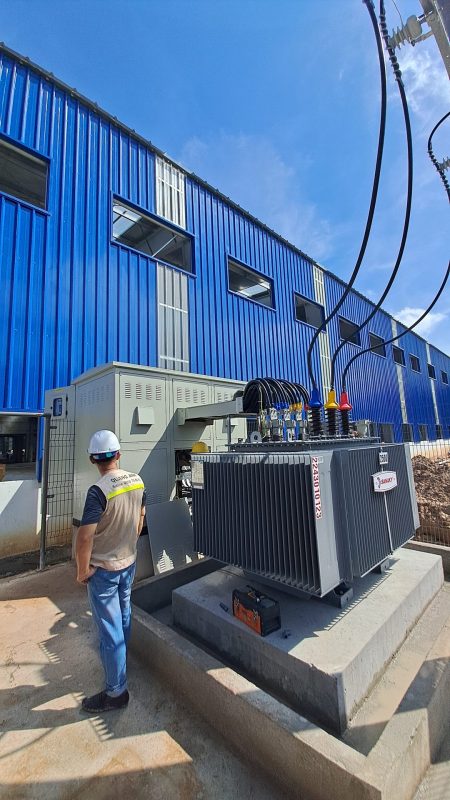
QuangAnhcons engineering guide. Retrofitting a substation in an operating factory is primarily an interface, isolation, protection and commissioning challenge—not just an equipment purchase. This guide explains the information an industrial owner and electrical contractor should agree before construction, using a clearly hypothetical 1,600 kVA, 22/0.4 kV screening example.
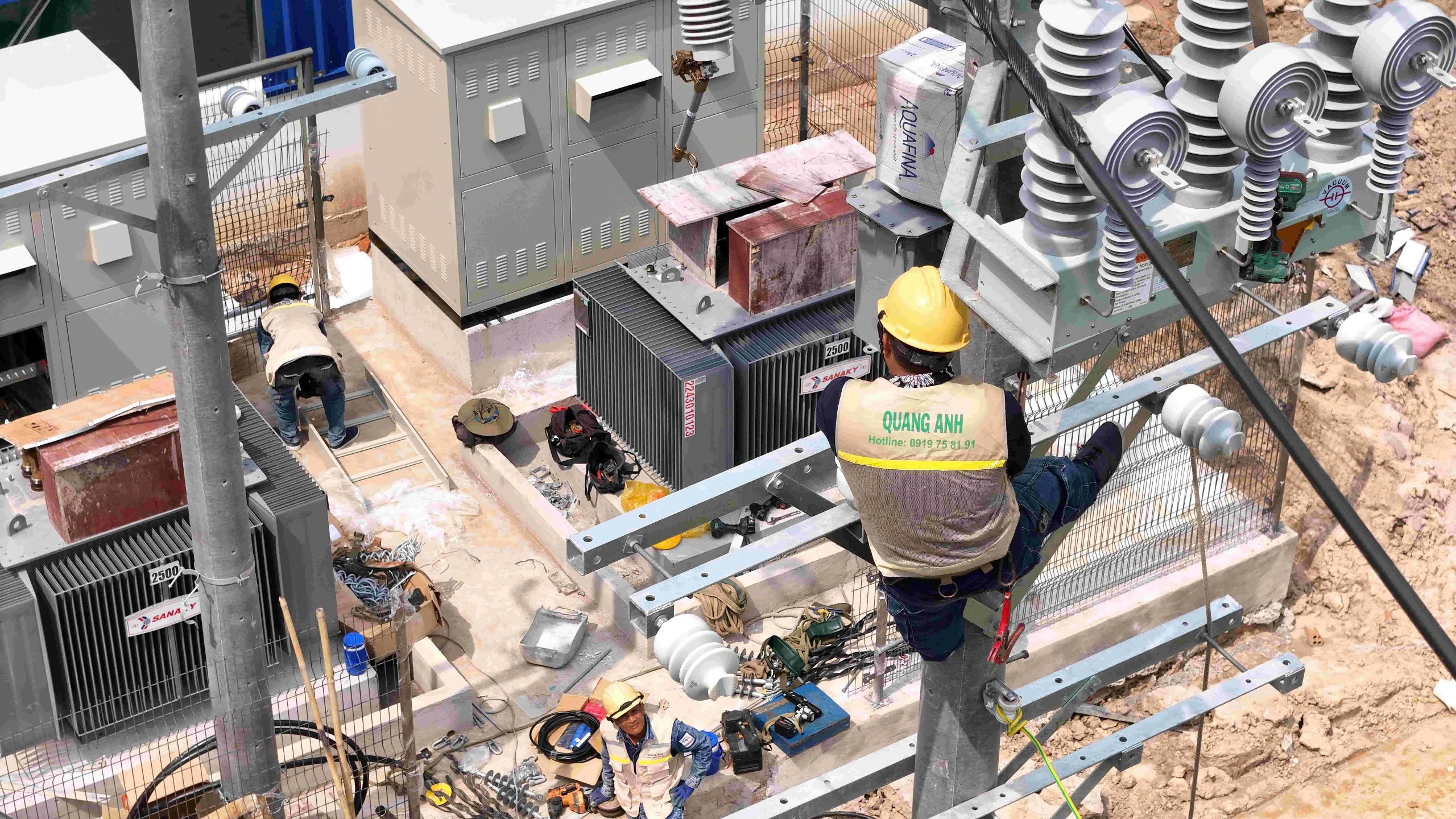
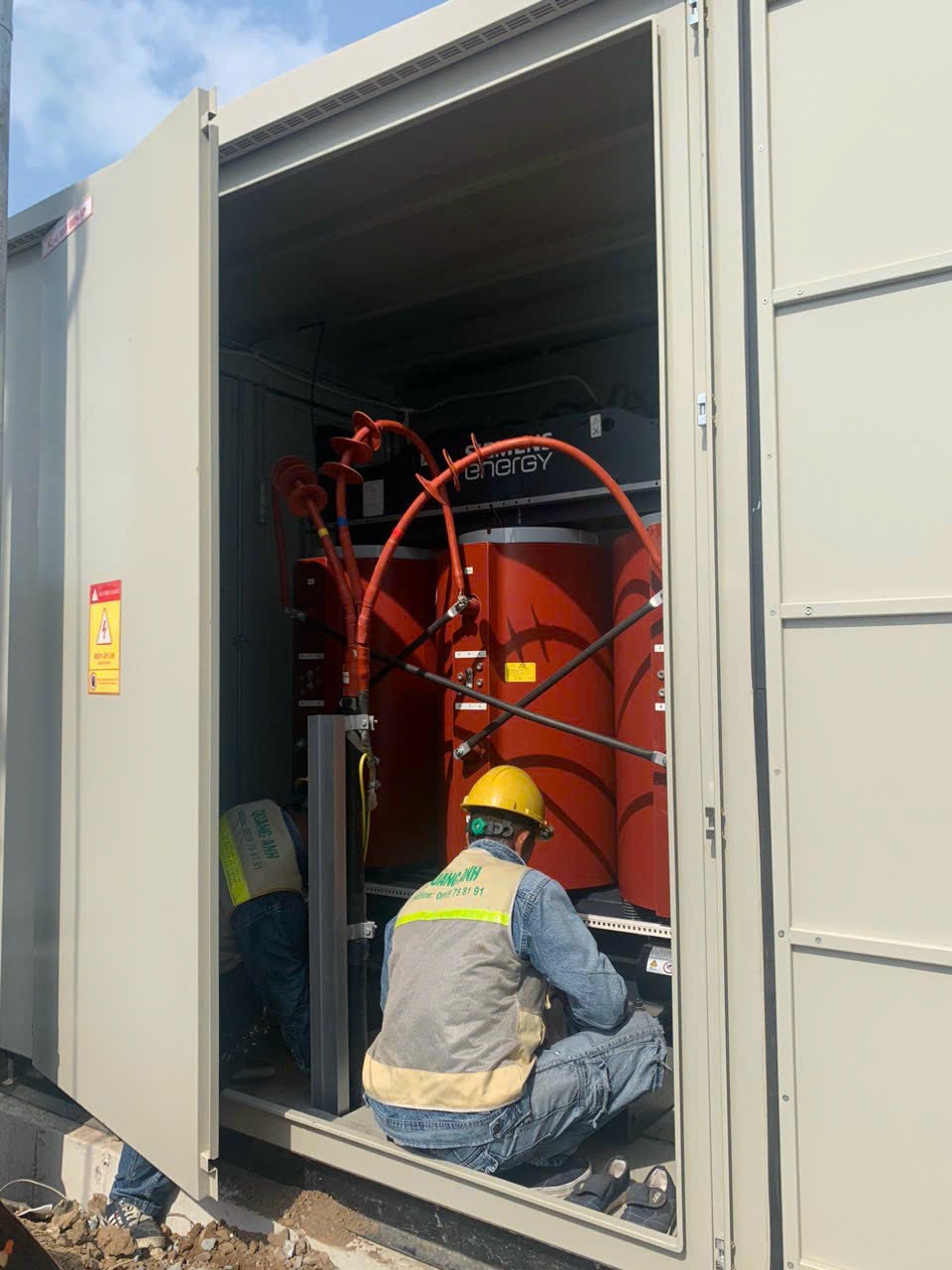
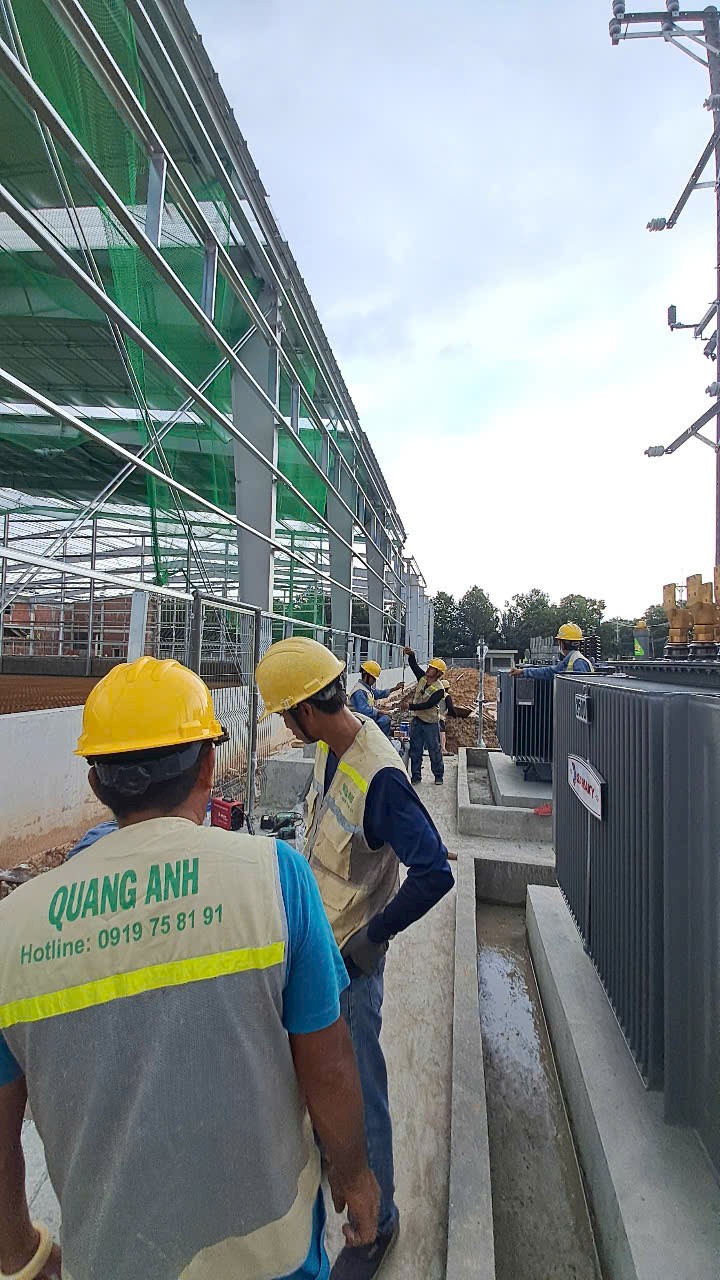
All numerical inputs below are illustrative, not site measurements, guarantees, commissioning receipts or design approvals. Historical QuangAnhcons site photographs illustrate construction context only. Electrical isolation and switching must be performed by authorized qualified personnel under approved site-specific procedures.
1. Start with an outage boundary, not an equipment brochure
Replacing a transformer, adding a factory medium-voltage feeder or extending a main switchboard inside an operating industrial facility is a brownfield project. The site may continue producing outside an approved outage window, but the electrical equipment being worked on must be demonstrably isolated and made safe. A quotation that names only a transformer rating and an installation duration leaves the most consequential interfaces undefined: which bus section loses supply, who authorizes switching, how stored energy is discharged, which loads need controlled shutdown, and who accepts the restored operating configuration.
For QuangAnhcons, a useful request for quotation is therefore an engineering interface package. It aligns the owner’s operations staff, their electrical responsible person, the utility or network operator where relevant, the equipment suppliers, and the installation/testing team. The contractor should not treat site occupancy as permission to perform energized installation work. Production continuity should be obtained by prior segregation, planned alternate supply and approved safe work sequencing, not by circumventing isolation controls.
The following method is a planning framework, not a switching instruction or certified design. Work procedures, protection settings, clearances, lockout/tagout and commissioning acceptance must be developed by qualified personnel under the project’s applicable Vietnamese legal requirements, approved design, equipment instructions and operational authority.
2. Define what is being modified and what must remain in service
Draw a before-and-after single-line diagram (SLD). Mark the point of common coupling, existing medium-voltage ring or radial supply, each switching device, transformer, LV main bus, coupling device, capacitor bank, power-quality equipment, generator/UPS interface and critical distribution board. A drawing labeled merely ‘existing’ does not prove its positions and ratings; field surveys should reconcile tags, physical routes, cable cores, nameplates and switchboard schedules against the actual installation.
Make a load continuity matrix with at least four classes: equipment that must be isolated for work; equipment that may stop within the approved outage; services requiring an alternative supply; and loads that are required to be safe rather than continuously running. Fire/life-safety obligations, ventilation, control systems, process interlocks and fire-pump configurations require separate specialist review. A normal-production kilowatt figure alone is not sufficient to define shutdown consequences or safe restoration.
State whether the goal is capacity expansion, resilience, new production-line connection, replacement due to equipment condition, reduction of maintenance exposure or compliance with a utility interface requirement. These objectives drive different designs. A second transformer installed beside an existing one is not automatic N−1 resilience: source commonality, LV sectionalization and the load surviving after one unit is unavailable must all be evaluated.
3. Make the survey evidence falsifiable
Collect photos with equipment tags and location context, but maintain a separate verified asset register. A photograph of an open transformer bay may illustrate access requirements; it must not be presented as evidence that a fictional case study was built or commissioned. Where photographs are from the company’s archive, label them as contextual historical project images and avoid exposing private plates, personal information or third-party branding.
The minimum engineering survey includes panel nameplates, transformer serial and vector-group data, impedance and tap information, utility interface drawings, short-circuit study inputs, existing cable routes, cable test records, as-built earthing drawings, civil constraints, access routes, drainage and flood levels. Record whether floor penetrations are fire-rated and whether proposed new ducts could compromise water exclusion or egress. Confirm site-specific underground utilities before any trenching or anchor installation.
Instrumented load measurements should represent defined operating scenarios rather than an unexplained average. If historical data are available, document the metering interval, peak period, power factor, harmonics, line-to-line voltage balance, motor starts and standby/seasonal cases. If measurements are missing, classify the load estimate as provisional and price a study allowance, not a fabricated level of engineering certainty.
4. Worked screening example: a 1,600 kVA transformer
Consider a hypothetical three-phase 22/0.4 kV distribution transformer rated 1,600 kVA. For a balanced three-phase apparent-power screening calculation, I = S / (sqrt(3) × ULL), with S in VA and line-to-line U in V. At nominal 22,000 V, the nameplate-side current is 1,600,000 / (sqrt(3) × 22,000) = approximately 41.99 A. At nominal 400 V the corresponding reference current is 1,600,000 / (sqrt(3) × 400) = approximately 2,309.40 A.
Neither number is a proposed relay pickup nor a breaker selection. The LV incomer frame and settings depend on actual load current, allowed transformer loading, switchboard rated current and thermal verification, cable installation conditions, fault levels, selective protection and operating scenarios. The MV protection must consider transformer inrush, upstream coordination, earth faults, utility requirements and the selected protective devices. Do not multiply transformer rated kVA by an arbitrary demand factor and pretend the reduced number is the equipment’s new nameplate rating.
The ratio of reference currents is a useful check against a one-thousand-fold unit error; it is not a substitute for a network model. Confirm terminal voltages and the actual equipment nameplate before working calculations enter a construction design.
5. A readiness gate before procurement
Freeze a design-basis register with clearly marked verified values, contractual design assumptions and unresolved issues. A switchboard drawing should identify incomer and feeder rated currents, withstand capability, short-circuit protection, earthing and neutral configuration, metering, CT/VT interface, interlocking and auxiliary control supply. For any new transformer, document cooling, losses, impedance tolerance, acoustic limits where applicable, transport mass and lifting points, enclosure ventilation and maintenance clearances.
Supplier submittals are not interchangeable with commissioning approvals. A compliant equipment family still needs the exact assembled configuration, genuine type/design verification evidence applicable to that assembly, interface dimension checks and the agreed inspection and test plan. Avoid purchasing cable accessories, MV termination kits or CTs from a headline rating alone: screen size, insulation type, conductor construction, short-circuit duration and the actual termination interfaces matter.
For a factory expansion, explicitly control long-lead equipment release. A change to transformer impedance or LV busway termination can invalidate an accepted fault study and switchboard layout. Price and schedule a defined engineering hold point prior to irreversible manufacture.
6. Physical access and temporary construction interfaces
Survey lifting access as an engineered activity. A crane location must be evaluated for capacity at radius, ground bearing and obstructions, not selected merely because the vehicle can enter the gate. Lifting and transport plans need equipment mass and center of gravity from verified drawings, route clearances, entry elevations, exclusion zones, site traffic control and competent supervision. Do not imply that a photograph of workers near an electrical cabinet demonstrates safe lift design.
Separate operational movement from construction zones with approved barricades, permits and escort rules. In a congested factory, cable trays and underfloor ducts may share space with piping, fire protection, mechanical services and moving equipment. Survey interfaces before fabrication; an electrically adequate route may still be unbuildable or unsafe. Assess dust, vibration, temporary power and shutdown noise impacts with the site’s operations team.
Where a new transformer or kiosk is added beside production, include water ingress, corrosion environment, enclosure heat rejection and maintenance access in the civil–electrical interface review. Prefabricated foundations and cable-entry plinths require actual manufacturer coordination; avoid using generic catalog dimensions as site-approved civil detail.
7. Treat the outage plan as a controlled technical deliverable
Build the outage plan backwards from a signed acceptance criterion. First define the restoration state and test evidence, then identify required pre-tests, isolation boundaries, installation work, checks, energization approval and operating handover. The switching authority should identify every energy source and every permit boundary, including standby generation, UPS backfeed, capacitors, PV and any battery energy storage system. Energy storage may retain hazardous potentials even with upstream supply disconnected.
Document a work permit and lockout/tagout process approved by the site: authorization, physical isolation, verification of absence of voltage by appropriate methods, grounding/earthing where required, controlled testing, release of protection and supervised re-energization. Site switching is performed by authorized qualified persons against approved procedures, not from instructions in a public article. No project deadline justifies bypassing this order.
For each outage activity, define prerequisites and a stop/no-go criterion. Examples include delivery completed, QA documents received, settings reviewed, temporary barriers accepted, isolation plan signed and emergency restoration arrangements approved. Keep an independent rollback plan: what is physically possible if installation or test fails, how long it takes, and who decides when production must remain stopped.
8. Example of an interface and evidence register
An interface register prevents a cable from reaching a transformer chamber before the termination space is confirmed. Every interface should have an owner, design evidence, acceptance criterion, review date and current open/closed status. The factory owner retains responsibility for operating priorities, while engineering disciplines retain responsibility for their respective verified design deliverables.
The register below illustrates the format only. Its headings are deliverables, not proof that any particular factory has been assessed. The electrical responsible person should insert project-specific acceptance limits and actual named accountable teams; a generic checklist must never impersonate signed site permits.
| Interface | Required evidence | Acceptance owner |
|---|---|---|
| MV supply and utility | Approved boundary drawing, device tags, switching responsibility and utility conditions | Operator / electrical responsible person |
| Transformer and LV board | Nameplates, impedance, ratings, terminations and protection coordination report | Electrical designer / equipment verifier |
| Factory operations | Shutdown matrix, load priorities, temporary supply review and rollback decision | Facility and production managers |
| Civil and lifting | Verified mass, floor/ground bearing, access and lift planning | Competent civil/lifting teams |
| Testing and handover | Inspection records, instrument IDs, signed tests, punch list and as-builts | Commissioning team / owner representative |
9. Protection and earthing are not late-stage accessories
Before specifying breaker interrupting capacity, calculate credible maximum and minimum fault cases at the correct equipment location, accounting for upstream source impedance, transformer impedance and permissible parallel-source configurations. Compare the calculated duty with the actual tested/declared ratings and time-current behavior of protective devices. Check disconnection and discrimination according to the actual earthing scheme and selected applicable installation rules; fault level and protective-earth continuity are connected design tasks, not separate purchasing options.
A reused LV switchboard may have insufficient thermal headroom, short-time withstand or physical termination area even if its main breaker ampere frame appears adequate. Where the design requires an existing bus-tie or changeover, verify mechanical/electrical interlocks and written operating philosophy. Prevent accidental source paralleling unless that mode was deliberately engineered and approved.
Earthing verification requires more than a single generic earth resistance number. The appropriate measurement and acceptance tests depend on the network earthing arrangement, touch/step risk, protection operating principle and site-specific design. Bonding of cabinets, cable screens, metallic enclosures, structural parts and protective conductors needs an approved scheme with recorded continuity and inspections.
10. Testing and commissioning: separate records by stage
Prior to energization, inspect mechanical fixation, equipment clearances, cable support, ferruling, protective covers, torque records against manufacturer values, labeling and approved construction deviations. Confirm the condition of insulation, cable sheaths, terminations and earthing before applying test voltages. Testing requirements and permissible test values depend on cable type, equipment data, the applicable standard and manufacturer procedure; a blanket test voltage copied from another job can damage equipment.
Evidence should distinguish factory acceptance tests (FAT), delivered-equipment inspection, site acceptance tests (SAT), pre-energization verifications, functional interlock checks, protection secondary tests and post-energization monitoring. A vendor factory report does not establish the correct field cable installation. A signed setting sheet does not establish breaker primary circuit integrity. An energized plant is not the same as a completed handover.
Record outstanding defects by severity and affected function, with formal acceptance of any safe temporary constraints. Preserve as-built SLDs, protection setting files, calibrated instrument identifiers, test reports, inspection photographs and the final load/quality monitoring baseline in a controlled handover set.
11. Standards: identify the scope, edition and project selection
IEC 61439-1:2020 covers general rules for low-voltage switchgear and controlgear assemblies; apply the relevant additional part, often IEC 61439-2 for power switchgear and controlgear assemblies, together with the actual project specification. It is incorrect to cite Part 1 alone as a blanket certificate for an assembled MSB. IEC 60076 addresses power transformer requirements by relevant part; the transformer maker’s exact documents and agreed project tests remain essential.
IEC 62271 equipment standards may apply to selected MV switchgear; the relevant part depends on the equipment and switching technology. For prefabricated AC substations within the stated scope, IEC 62271-202:2022 describes service conditions, characteristics, construction and test methods. Do not automatically apply the complete prefabricated-substation standard to a standalone indoor transformer in an existing room.
Vietnamese regulations, utility rules, fire-safety requirements and the project’s approved TCVN/IEC edition may impose additional binding constraints. Legal applicability, transitions and approval routes should be verified by qualified project professionals rather than inferred from a public educational article.
12. Build an RFQ that a contractor can actually price
Ask for a pack with an existing and proposed SLD, electrical load schedule with measured periods, existing and proposed equipment ratings, available short-circuit data, site photographs with protected sensitive details, civil plan, route lengths, cable method, working-hour limitations, outage restrictions, proposed temporary supply and permit interface. Separate known information from unknown information. Unknown transformer impedance, cable length or utility fault level should become explicit design clarifications instead of hidden contingencies.
Break down offers into survey, engineering coordination, equipment supply, civil and cable installation, specialist tests, shutdown support, energization assistance, as-built handover and warranty assumptions. Price optional outage windows and temporary works separately when the owner has not finalized them. Mark the permit and network-operator approvals that must precede execution. QuangAnhcons can review the available scope and propose an engineering survey; a preliminary online estimate is not a certified construction design.
For a practical discussion, send the project location, tentative capacity, voltage levels, latest SLD and proposed outage limits to sales@quanganhcgte.com. The response can identify information gaps before the parties commit to equipment models or dates.
13. Frequently asked engineering questions
Can the new transformer be installed while the factory operates? Construction may proceed in segregated approved areas only under the site’s safe-work system; any electrical connection to energized distribution equipment requires a separately approved safe method and may require a shutdown. ‘Live plant’ describes a production environment, not permission for energized electrical work.
Can a 1,600 kVA transformer feed any MSB labeled 2,500 A? No. A nominal current comparison is insufficient. Verify the switchboard assembly rating, protective devices, busbar temperature rise, short-circuit capacity, connection geometry, installation conditions, loads and project-specific protection study.
Can photos from an old QuangAnhcons project prove the worked example? No. Historical media illustrate construction context only. The worked figures in this guide are hypothetical; no actual customer, commissioning result or manufacturer certification is asserted.
Technical reference notes
Primary standard scope summaries: IEC 61439-1:2020 (low-voltage assemblies) and IEC 62271-202:2022 (prefabricated AC substations). Check the equipment-specific IEC 60076 and IEC 62271 parts, applicable current Vietnamese regulations and utility rules, project contract, and manufacturers’ validated data before selecting design limits.
Request an engineering review: Email sales@quanganhcgte.com with the existing SLD, available transformer/board data, plant location and proposed shutdown window. This article is educational and does not constitute a binding quotation or certified electrical design.
[contact-form-7 id="7239967" title="Contact form 1"]
Related Posts
Factory Substation Retrofit: Isolation, Tie-In and Commissioning Plan for an Operating Plant
Brownfield factory substation retrofit guide covering outage planning, electrical isolation, MV/LV interfaces, protection studies, commissioning [...]
Oct
2x2500kVA Transformer Substation for RVN Fibers Successfully Completed
2x2500kVA Transformer Substation Project for RVN Fibers Company – Successfully Completed with High Technical Standards [...]
Jan
Everything You Need to Know About the 7500kVA Transformer
The 7500kVA transformer is a high-capacity electrical device widely used in industrial facilities, factories, and [...]
Dec
Transformer Station Construction Services
Transformer Station Construction Services Introduction Transformer stations are the backbone of any industrial electrical infrastructure. [...]
Dec
Reliable Transformer Station Construction Services by QuangAnhcons
Professional Transformer Station Construction Services – QuangAnhcons With extensive experience and a commitment to excellence [...]
Nov
Effective and Safe Installation Guide for 560kVA Transformer Station
In modern industry, installing a 560kVA transformer station plays a crucial role in ensuring stable [...]
Jul
Professional and Reliable 400kVA Transformer Station Contractor
Quang Anh CE Co., LTD is proud to be a professional and reliable contractor for [...]
Jul
Efficient Fault Isolation and Quick Power Restoration with 3P 27kV 630A Recloser Installation
The installation of a 3P 27kV 630A recloser, FDX control cabinet, and a DS 3P [...]
Apr